

 Emergency fund
 10 steps
Quick answer: how to plan for retirement
- Log in to Meu INSS, check your contribution statement (CNIS) and use “Simular Aposentadoria” (Simulate Retirement) to see when and with how much you can retire.
- Set the monthly income you want and subtract the estimated INSS benefit: the difference is what you need to build.
- Keep your INSS contributions up to date, even if you're self-employed or an MEI.
- With an emergency fund ready and no expensive debt, invest every month for the long term: Tesouro RendA+, private pension (PGBL or VGBL) or other investments.
- Review the plan every year and distrust any contact “from INSS” asking for data or money.
What's your case?
How to plan for retirement: 10 steps
1Check your CNIS and simulate on Meu INSS
- Go to gov.br/meuinss (or the Meu INSS app) with your CPF and gov.br password.
- Download the Contribution Statement (CNIS) and check that all your jobs and contributions are there. Missing a period? Gather your work card and pay slips and request a correction.
- Use “Simular Aposentadoria”: the service is free and shows which rules apply to you and how long is left.
- According to INSS, the simulation is a reference and doesn't guarantee the benefit. Questions: call 135, Monday to Saturday, 7 a.m. to 10 p.m. (Brasília time).
2Understand INSS rules in 2026
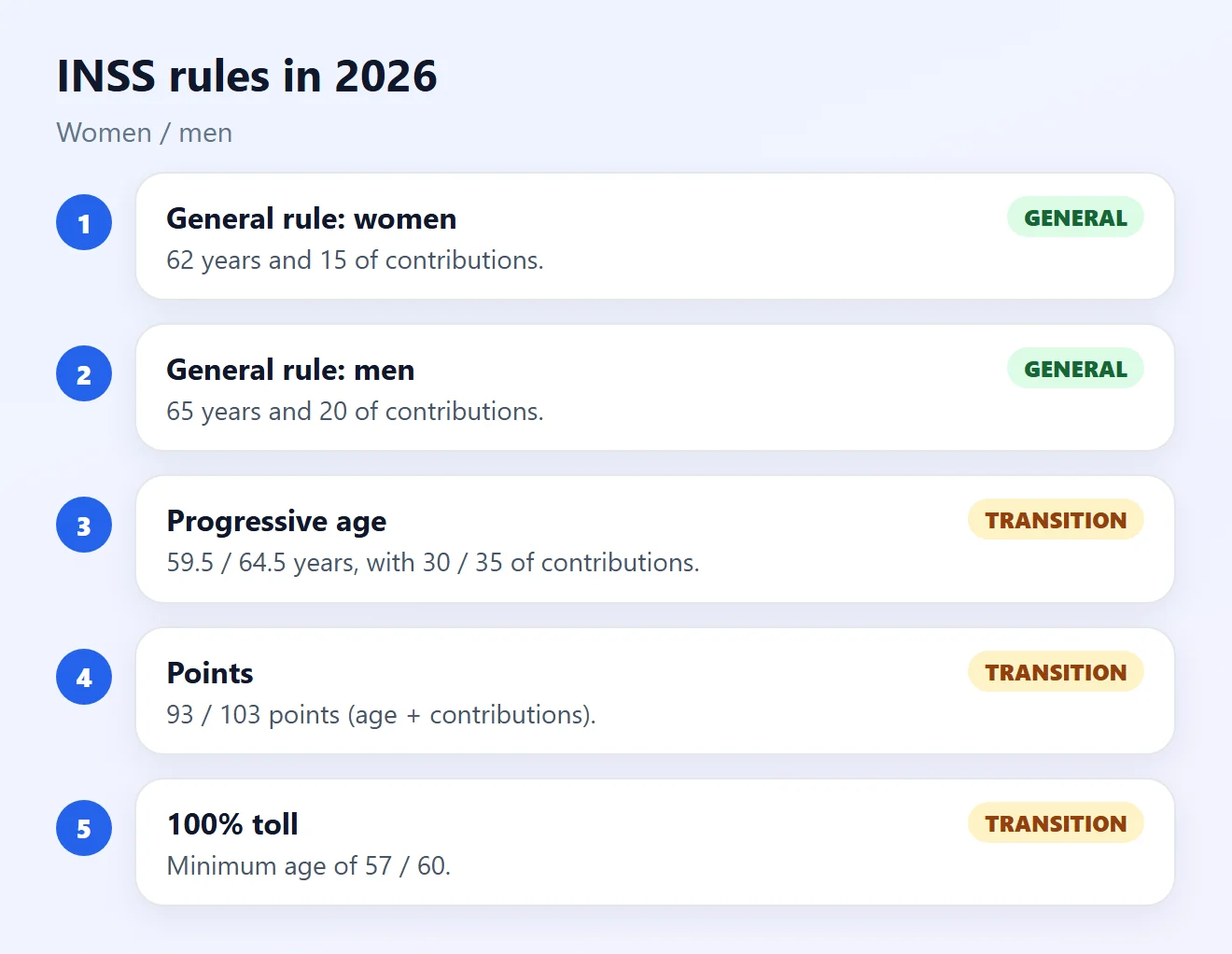
- General rule (2019 Pension Reform): women at 62 with 15 years of contributions; men at 65 with 20 years. Men who started contributing before November 2019 need at least 15 years.
- People who were already contributing before the reform may fit a transition rule. In 2026:
- progressive minimum age: 59 years and 6 months (women) and 64 years and 6 months (men), with 30 and 35 years of contributions;
- points (age + contribution years): 93 (women) and 103 (men);
- 100% toll: minimum age of 57 (women) and 60 (men).
- Transition ages and points rise every year. The Meu INSS simulator shows which rule is best for you.
- The amount depends on your average contributions and years contributed, and ranges from the R$ 1,621 floor to the R$ 8,475.55 ceiling (2026 values).
3Work out how much is missing for your target income
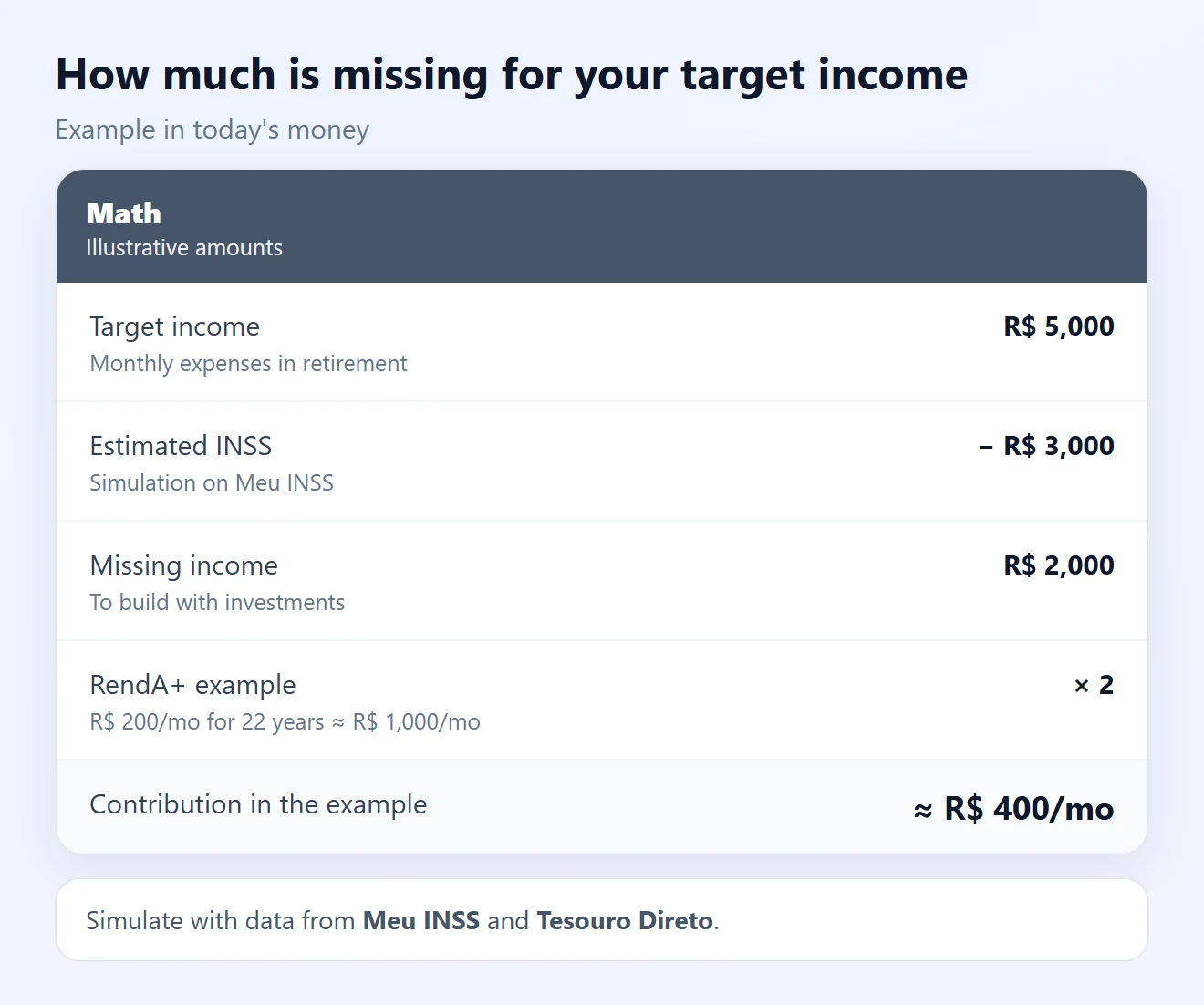
- Estimate your monthly expenses in retirement in today's money. Add health care and medicine, which tend to rise with age, and remove what will end, like a mortgage.
- Subtract the estimated INSS benefit. Example: you want R$ 5,000, the simulator shows R$ 3,000, so R$ 2,000 a month is missing.
- In Tesouro Direto's RendA+ example, about R$ 200 a month for 22 years produces R$ 1,000 a month for 20 years (simulation with a 5% real annual rate). For R$ 2,000, that's about R$ 400 a month.
- Use the official simulators and the Central Bank's Citizen Calculator to test terms and amounts.
4Keep your INSS contributions up to date
- With a formal job, the contribution comes out of your salary: check on the CNIS that it's arriving.
- Self-employed, MEI or without income (homemakers, students) can contribute on their own and keep INSS protection: retirement, disability benefit and a pension for the family.
- Reduced-rate plans, like the MEI one, give access to fewer benefits. Check the rules on Meu INSS before choosing.
- Late contributions don't always count: get up to date soon.
Self-employed? See emergency fund for the self-employed.
5Before investing: emergency fund and debt
- Retirement money is long-term. If you dip into it for every emergency, the plan stalls: build the emergency fund first.
- Credit card and overdraft interest is higher than any investment return: pay off expensive debt first.
See how to build an emergency fund and how to get out of debt.
6Tesouro RendA+: a government bond made for retirement
- You invest during the accumulation phase and, starting in the year in the bond's name (for example, RendA+ 2050), receive 240 monthly payments over 20 years, adjusted for inflation (IPCA).
- Contributions aren't mandatory: you can invest whenever you want, from 1% of a bond.
- Without early redemption, there's no B3 custody fee. Redeeming early is possible, but may have costs and the price varies with the market.
- Income tax applies only to the earnings portion of each payment, at a regressive rate.
7Private pension: PGBL, VGBL and company plans
- PGBL: lets you deduct contributions up to 12% of gross annual income if you file the full income tax return and contribute to INSS or a public-servant regime. On withdrawal, tax applies to the total amount.
- VGBL: no tax deduction, but on withdrawal tax applies only to the earnings. It usually suits those who file the simplified return.
- Progressive or regressive tax table: since Law 14,803/2024, you can choose until the first benefit or withdrawal, and the choice can't be undone. The regressive table tends to pay off if you stay many years.
- Compare fees: management and loading fees can eat much of the gain. If the plan is expensive, portability to another plan of the same type is allowed.
- If your employer offers a pension plan with matching contributions, where it deposits too, give it priority.
8Invest every month, automatically
- The earlier you start, the smaller the monthly amount: returns build up for longer.
- Schedule the contribution for payday and increase it whenever your income goes up or a payment ends.
- For the long term, prefer inflation-protected investments, such as IPCA-linked bonds, and diversify.
- Don't use retirement money for betting or get-rich-quick promises.
9Review the plan every year
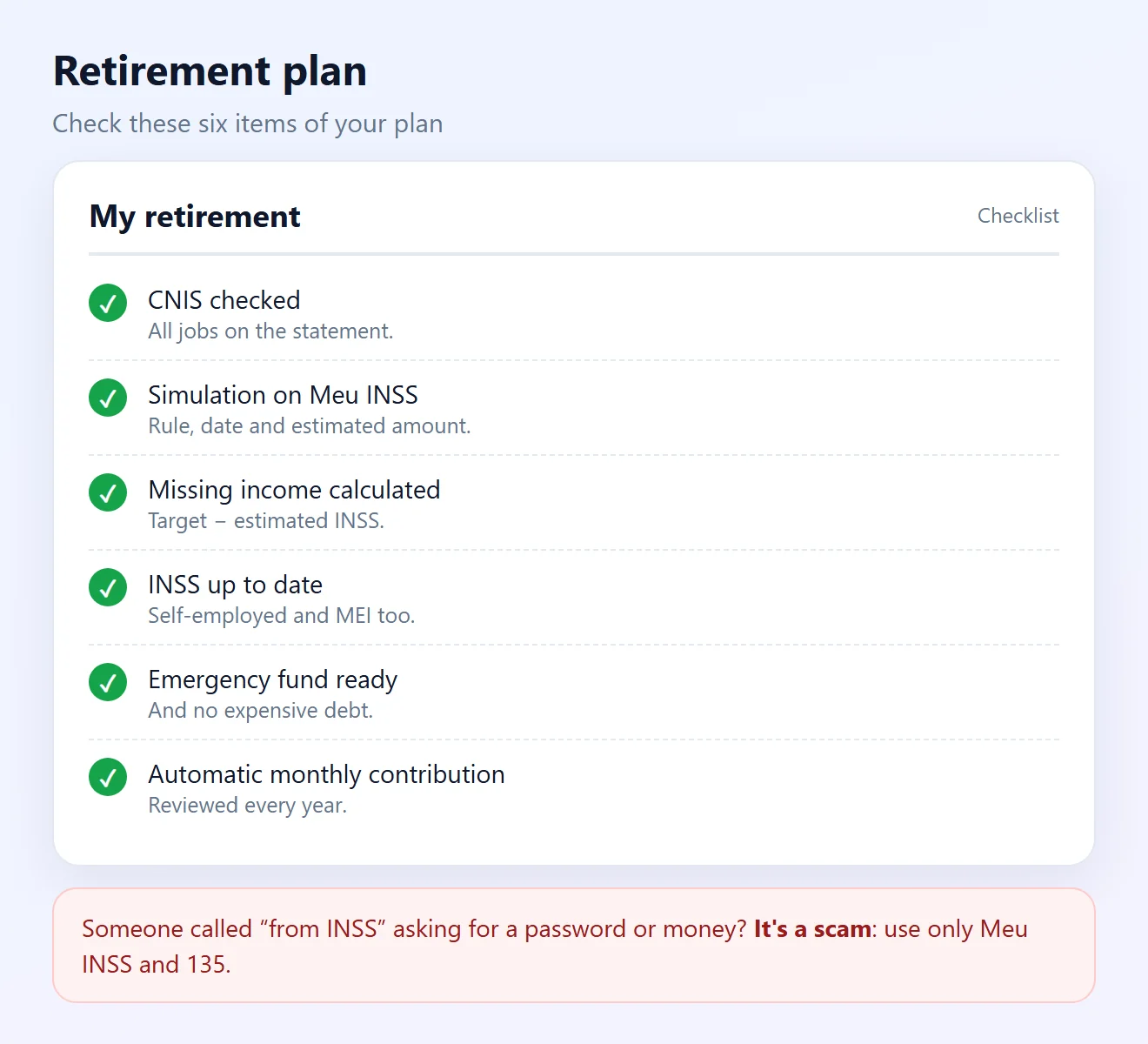
- Once a year, redo the Meu INSS simulation, check the CNIS and see how much you've saved.
- Adjust contributions when something changes: job, children, home ownership, health.
- Close to retirement, move part of the money to less volatile investments and plan your income month by month.
10Protect yourself from scams against retirees
- INSS doesn't call, send links or ask for passwords or money to release or review a benefit. No one from INSS will come to your home.
- Use only the official channels: Meu INSS and phone 135.
- On Meu INSS, under “Consultar Descontos de Entidades Associativas”, check for deductions from your benefit you didn't authorize, and dispute them on Meu INSS or by calling 135.
- Be wary of “guaranteed review” or “faster retirement” sold by middlemen. Applying for a benefit at INSS is free.
Situation and what to do
| Situation | Likely cause | What to do |
|---|---|---|
| I don't know when I'll retire | Never simulated | Simulate on Meu INSS (step 1) |
| A job is missing from the CNIS | Contribution not recorded | Gather documents and request a correction (step 1) |
| INSS won't be enough | Income above the benefit | Work out the gap and invest (steps 3 and 8) |
| I'm self-employed and don't contribute | No INSS protection | Contribute on your own (step 4) |
| My pension earns little | High fees | Compare fees and consider portability (step 7) |
| Strange deduction from my benefit | Unauthorized deduction | Check and dispute on Meu INSS (step 10) |
Frequently asked questions
How do I find out how long until I can retire?
On Meu INSS, use the “Simular Aposentadoria” service. It's free and shows the rules that apply to you. The simulation is a reference and doesn't guarantee the benefit.
What is the minimum retirement age in 2026?
Under the general rule, 62 for women (with 15 years of contributions) and 65 for men (with 20 years, or 15 for those contributing before November 2019). Transition rules may allow lower ages.
What is the INSS ceiling in 2026?
R$ 8,475.55 a month. The floor is R$ 1,621, equal to the minimum wage.
How much should I invest monthly to supplement INSS?
It depends on the missing income and the time frame. In Tesouro Direto's example, about R$ 200 a month for 22 years in RendA+ produces R$ 1,000 a month for 20 years, at a 5% real annual rate.
What is Tesouro RendA+?
A government bond for retirement: you invest during the accumulation phase and then receive 240 inflation-adjusted monthly payments over 20 years.
PGBL or VGBL: which should I choose?
PGBL usually suits those who file the full income tax return and contribute to official social security, since it allows deducting up to 12% of gross income. VGBL suits those who file the simplified return.
When do I choose between the progressive and regressive table?
Under Law 14,803/2024, you can choose until the first benefit or withdrawal, and the choice can't be undone afterwards.
Can self-employed people retire through INSS?
Yes, by contributing on their own as individual contributors or MEI. Rules and benefits vary with the rate chosen.
Does INSS call to ask for personal data?
No. INSS doesn't call, send links or ask for passwords. The official channels are Meu INSS and phone 135.
How often should I review the plan?
At least once a year and whenever something important changes, like your job, income or family.
Related content
More practical solutions in Emergency fund.

How to Build an Emergency Fund From Scratch
Learn how to build an emergency fund from scratch, estimate a realistic target, save consistently, and keep the money available for unexpected essential expenses.
 20 minutes
How to build an emergency fund when self-employed
Aprenda the montar a fund of emergency mesmo with income variável. Veja quanto guardar, as definir goals and onde manter the money for lidar with períodos of baixa demanda or unexpected events.
15 minutes
Financial Education for Children: How to Teach It Early
Learn how to teach financial education to children and teenagers through practical examples, goals, conscious allowances, and healthy spending habits.
30 minutes
Sources consulted
- INSS: Retirement rules change in 2026 (in Portuguese)
- INSS: Programmed retirement (in Portuguese)
- INSS: Urban retirement by age (in Portuguese)
- INSS: R$ 8,475.55 ceiling in 2026 (in Portuguese)
- Tesouro Direto: Plan your retirement with RendA+ (in Portuguese)
- SUSEP: PGBL and VGBL (in Portuguese)
- Planalto: Law 14,803/2024 on choosing the tax regime (in Portuguese)
- Secom: unauthorized deductions can be disputed on Meu INSS or 135 (in Portuguese)
- Secom: scammers approach retirees promising refunds (in Portuguese)
The images on this page are illustrations created by Fixfy. Amounts are examples. INSS rules, taxes and fees change over time: check on Meu INSS and with the institution before deciding.