

 Debt
 10 steps
Quick answer: where to start
- List all your debts with balance and interest. See your bank debts for free in Brazil's Central Bank Registrato.
- Find out how much is left each month after essential bills. That's the amount for your plan.
- Stop taking on new debt: no paying just the card minimum and no using the overdraft.
- Protect your home, car and essential bills, then attack the debt with the highest interest.
- Negotiate in writing, swap expensive debt for cheaper debt and, if nothing fits your income, get help under the over-indebtedness law.
What's your case?
30-day plan to get back in the black
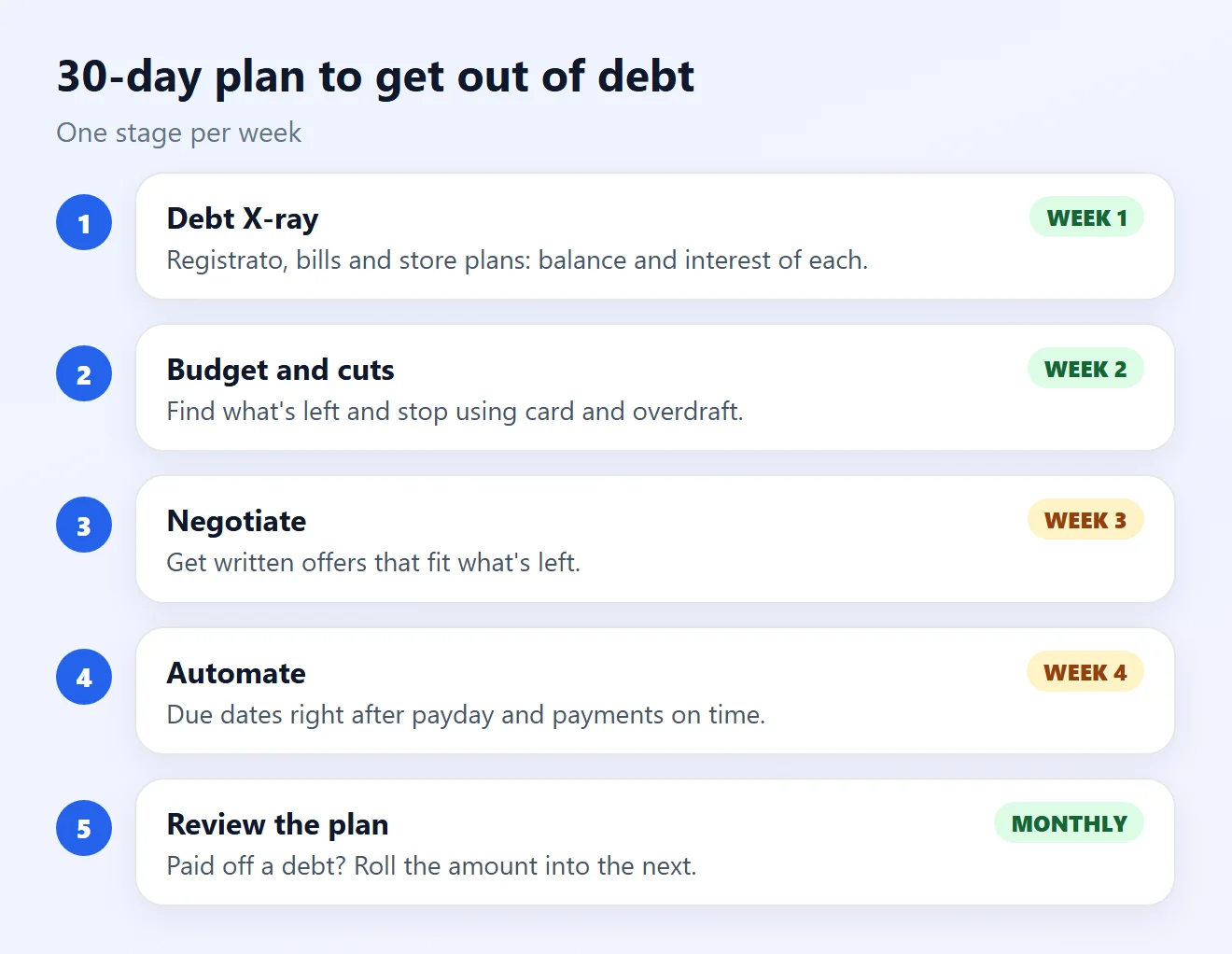
Follow the 10 steps below in this order. In one month you'll know exactly how much you owe, how much you can pay and have your agreements in writing.
How to get out of debt: 10 steps
1X-ray all your debts
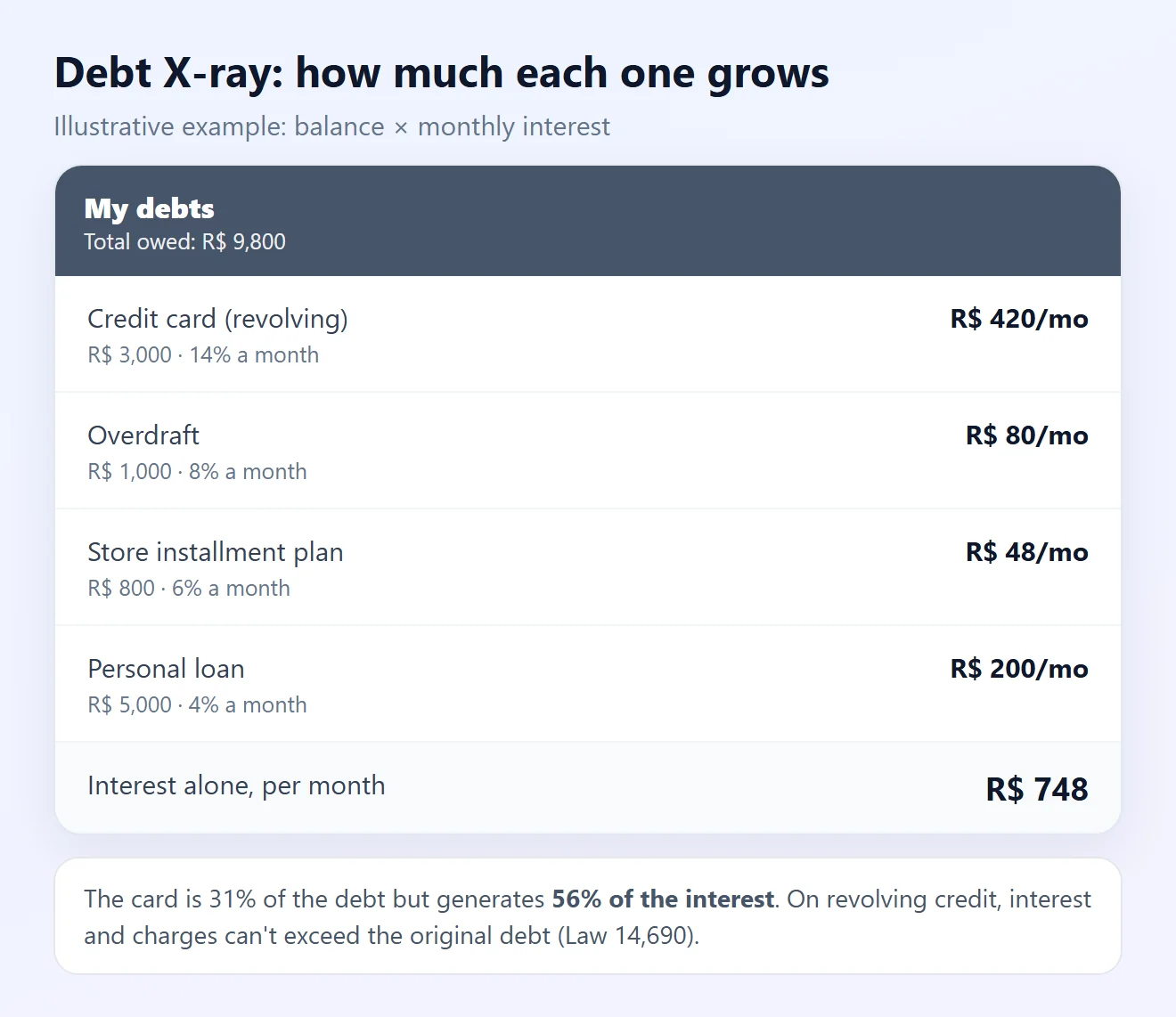
- For each debt, note the creditor, balance, monthly interest, installment, due date and whether it's overdue.
- See loans, financing, cards and overdraft in the Central Bank's Registrato, free, with a silver or gold gov.br account.
- Add what doesn't show up there: store installment plans, power and water bills, rent, debts to people.
- Multiply balance by interest: that's how much each debt grows per month. In the example, R$ 748 in interest alone.
2Find out how much is left each month
- Add up your net income for the month (what actually lands in your account).
- Subtract essentials: housing, food, power, water, gas, transportation, medicine.
- What's left is the amount for debts. Never promise a creditor more than that: a deal that doesn't fit becomes a new late payment.
- Cut non-essentials for a few months: subscriptions, delivery, installment purchases.
3Stop taking on new debt
- Don't pay just the card minimum: the rest goes to revolving credit, one of the most expensive kinds.
- Ask to lower or cancel the limit on your overdraft and card.
- Remove the card from shopping apps and avoid new installment purchases until expensive debts are paid off.
- Don't take a loan to pay another loan's installment without comparing the cost (step 8).
4Decide what to pay first
- First, whatever can cost you an essential asset: home and car financing, which use the asset as collateral.
- Then, essential bills that can be cut off: power, water and gas.
- Next, the debts with the highest interest (steps 5 and 6).
Already behind on installments? See overdue installments: what to do.
5Choose a method: avalanche or snowball
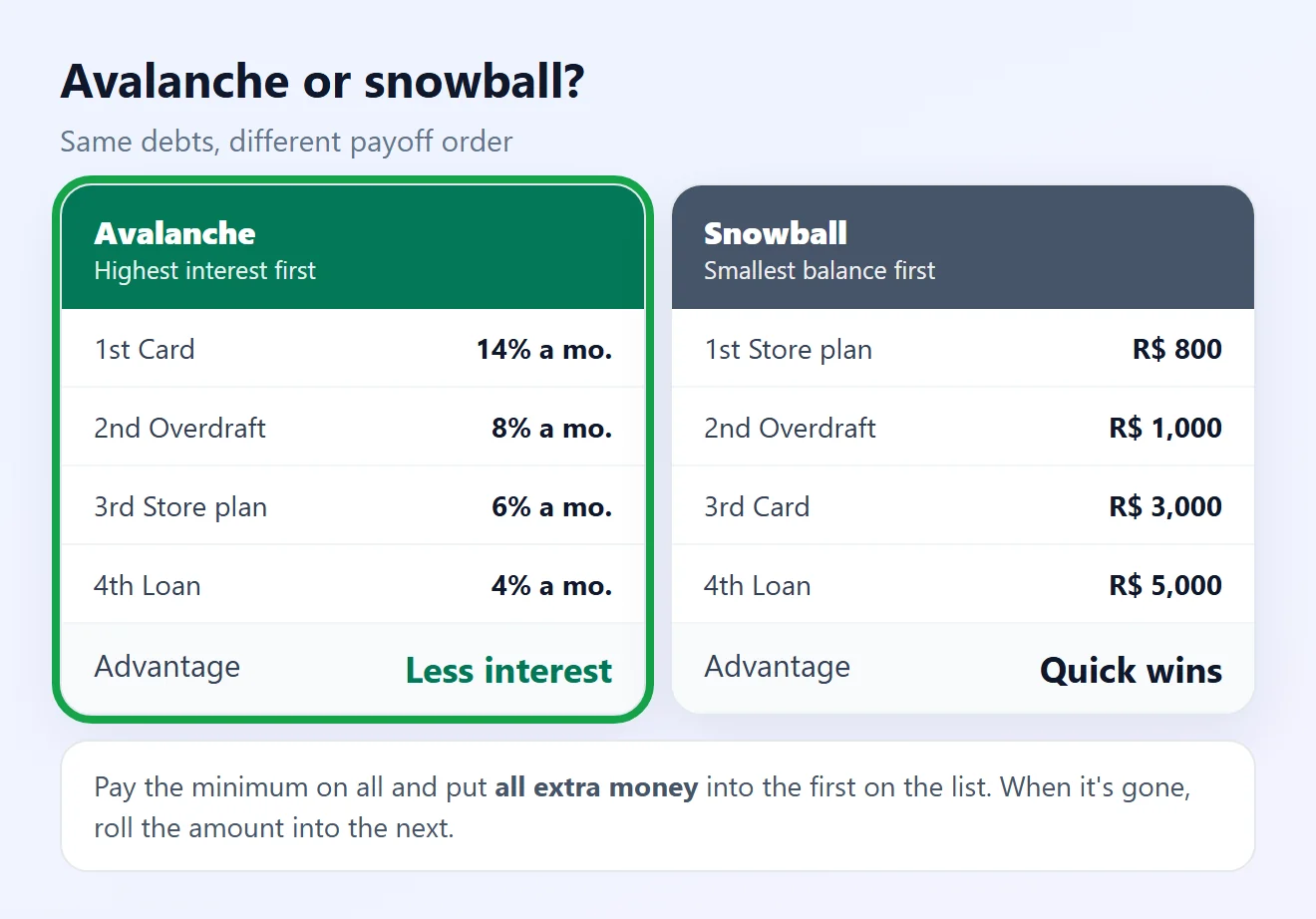
Pay the minimum on every debt and put all extra money into one. When it's gone, roll that amount into the next.
- Avalanche: start with the highest-interest debt. It's how you pay the least interest overall.
- Snowball: start with the smallest balance. You clear a debt faster, which helps keep you motivated.
The best method is the one you can stick with to the end.
6Cut credit card and overdraft interest
- Revolving card credit: total interest and charges can't exceed the original debt amount (Law 14,690/2023). You can ask to renegotiate at any time, within that limit (CMN Res. 5,112).
- Overdraft: interest is capped at 8% a month (CMN Res. 4,765), which is still over 150% a year. See how to get out of overdraft.
- If you have money sitting in savings, using part of it to pay off these debts usually saves a lot.
Learn how interest piles up in compound interest on debt.
7Negotiate with each creditor
- Contact the creditor through the official channel (app, website, customer service, branch) and say how much you can pay per month.
- Get the offer in writing: total amount, installments, CET and when your name leaves the credit records.
- Compare a lump-sum discount with installments in pay in full or in installments.
- No deal? File a complaint on consumidor.gov.br or with Procon.
Full walkthrough in how to negotiate bank debt.
8Swap expensive debt for cheaper debt
- A lower-interest loan (personal, payroll) can pay off revolving credit and overdraft at once.
- Through portability, another bank pays off your debt and you pay it instead, on better terms.
- Always compare the CET and the total to pay, not just the installment.
See when it's worth it in refinancing debt.
9Protect your name and know your rights
- Before being listed as a defaulter, you must receive written notice (CDC, art. 43, § 2).
- After you pay, the creditor has 5 business days to request removal of your name (STJ Precedent 548).
- Collection can't use threats, embarrassment or ridicule (CDC, art. 42).
- For late payment, banks may only charge contract interest, a late fee and late interest (CMN Res. 4,882).
Already listed? See negative credit record: how to check and clear it.
10If income doesn't cover it, use the over-indebtedness law
Over-indebtedness is when a person, in good faith, can't pay their consumer debts without compromising the existential minimum (CDC, art. 54-A). Today the existential minimum is R$ 600 a month (Decree 11,150/2022), an amount challenged at the Supreme Court.
- Procon and other consumer protection bodies can hold a conciliation with all creditors together (CDC, art. 104-C).
- In court, you can request debt restructuring and present a payment plan of up to 5 years (CDC, art. 104-A). The Public Defender's Office helps for free.
- Debts with real collateral, mortgages and rural credit are excluded.
Learn how to apply in over-indebtedness: what it is and how to get help. Once debts are paid, save a little every month in an emergency fund so you don't fall back into the red.
Situation and what to do
| Situation | Urgency | What to do |
|---|---|---|
| I don't know how much I owe or to whom | Medium | Registrato and a full list (step 1) |
| I only pay the card minimum | High | Stop revolving credit and renegotiate (steps 3 and 6) |
| I live in my overdraft | High | Swap for cheaper credit (step 8) |
| Home or car installment overdue | Very high | Prioritize and contact the creditor now (step 4) |
| Negative credit record | Medium | Negotiate and follow the removal (steps 7 and 9) |
| Income doesn't cover the basics | Very high | Procon or Public Defender: over-indebtedness (step 10) |
Frequently asked questions
What's the first step to get out of debt?
List all your debts with balance, interest and due date. Bank debts show up for free in the Central Bank's Registrato, with a silver or gold gov.br account.
Which debt should I pay first?
First, those that can cost you an essential asset (financed home and car) and essential bills. Then, the highest-interest one, such as revolving card credit and overdraft.
Which is better: avalanche or snowball?
Avalanche (highest interest first) spends less on interest. Snowball (smallest balance first) brings quick wins and helps you stay motivated. Choose the one you'll follow to the end.
Is credit card interest capped?
Yes. On revolving credit and bill installment plans, total interest and charges can't exceed the original debt amount (Law 14,690/2023 and CMN Res. 5,112).
What's the overdraft interest cap?
8% a month, under CMN Resolution 4,765. Even so, it's one of the most expensive kinds of credit: after a year without payments, the debt more than doubles.
Is it worth taking a loan to pay off debts?
It is if the new loan's CET is lower than the debts it will pay off and the installment fits your budget. Use the money only to pay off debts, directly to the creditor.
Does debt expire after 5 years?
After 5 years your name must leave the defaulter records (CDC, art. 43). That doesn't erase the debt at the creditor, which may still exist in its own records.
How long until my name is cleared after paying?
The creditor has 5 business days after payment to request removal of your name from the record (STJ Precedent 548).
What is over-indebtedness?
It's when a person, in good faith, can't pay their consumer debts without compromising the existential minimum. The law allows conciliation with all creditors at Procon or in court, with a plan of up to 5 years.
Where can I get free help?
At your city's Procon, the Public Defender's Office and consumidor.gov.br, for complaints against banks and companies.
Related content
More practical solutions in Debt.
Compound Interest on Debt: How to Understand and Prevent Balance Growth
Entenda how to the compound interest aumentam the amount of a debt to the longo of the time, how to identify the encargos cobrados and quais atitudes helpm the reducesir the impact financial.
 15 minutes
Negative Credit Record in Brazil: How to Check and Resolve Outstanding Debts
Learn how to check for a negative credit record in Brazil, identify outstanding debts, negotiate with creditors, and track the regularization of your CPF safely.
15 minutes
How to negotiate debt with a bank
Learn how to negotiate debt with a bank safely, compare offers, reduce interest, and organize installments without compromising your budget.
15 minutes
Sources
- Planalto: Consumer Protection Code (Law 8,078/1990), arts. 42, 43, 54-A, 104-A and 104-C (in Portuguese)
- Planalto: Decree 11,150/2022 (existential minimum, in Portuguese)
- Planalto: Law 14,690/2023, art. 28 (credit card interest cap, in Portuguese)
- Central Bank of Brazil: CMN Resolution 5,112/2023 (revolving credit and bill installments, in Portuguese)
- Central Bank of Brazil: CMN Resolution 4,765/2019 (overdraft, in Portuguese)
- Central Bank of Brazil: CMN Resolution 4,882/2020 (late payment charges, in Portuguese)
- STJ: five business days to request removal from the record (Precedent 548, in Portuguese)
- Central Bank of Brazil: Registrato (in Portuguese)
- Consumidor.gov.br: complaints against companies and banks (in Portuguese)
The screens and examples in this guide are illustrations created by Fixfy. The example rates are hypothetical; those in your contract may differ. Avalanche and snowball are money management methods, not legal rules. This content is informational and doesn't replace legal or financial advice.