

 Debt
 10 steps
Quick answer: what to do now
- Find the monthly and annual interest rate and the total effective cost (CET) in the contract, the bill or the app.
- Convert the rate to a year: 3% a month is 42.58% a year; 8% a month is 151.82%.
- Pay the most expensive debt first (revolving credit card and overdraft) and don't stick to the minimum payment.
- Pay installments early: Brazilian law guarantees a proportional interest discount.
- Swap the debt for cheaper credit or negotiate with the bank before you fall behind.
Which case is yours?
How to control compound interest on your debt: 10 steps
This guide follows Brazilian law and Brazil's Central Bank (BCB) rules. The math works the same anywhere.
- Find the rate and CETIn the contract, bill or app: monthly rate, annual rate and total to pay.See how →
- Convert it to a year2% a month becomes 26.82% a year. 8% a month, 151.82%.See how →
- Pay the priciest firstRevolving credit card and overdraft before anything else.See how →
- Pay installments earlyPaying early gets a proportional interest discount, by law.See how →
- Swap or negotiateCheaper credit, portability or a deal with the bank.See how →
1Understand interest on interest
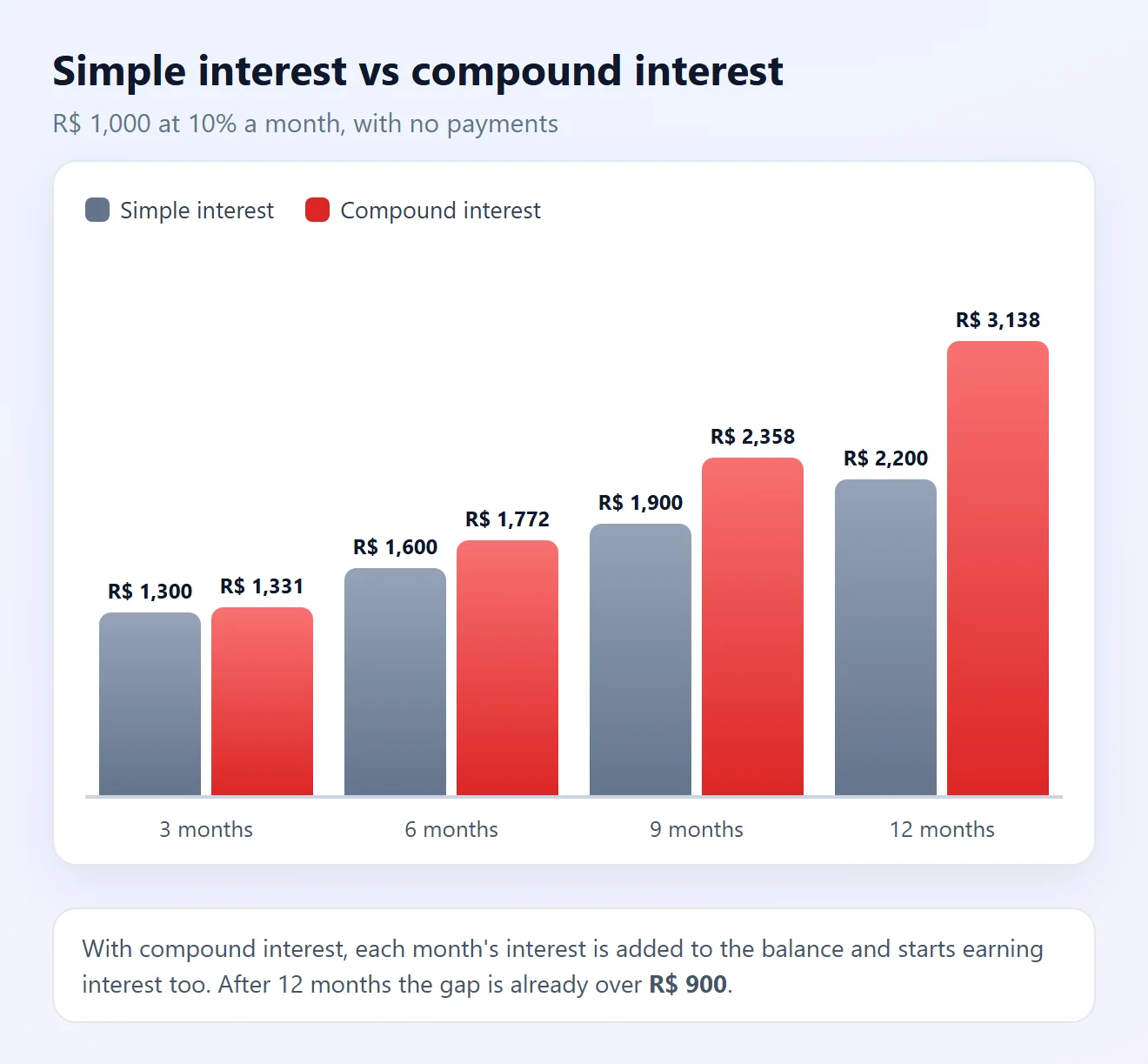
With simple interest, the rate always applies to the original amount. With compound interest, each month's interest is added to the balance and starts earning interest the next month. That is how credit cards, overdrafts and most loans work.
- Formula: balance = amount × (1 + rate)months.
- R$ 1,000 at 10% a month with no payments: R$ 2,200 after a year with simple interest and R$ 3,138 with compound interest.
- The longer the debt sits unpaid, the faster it grows. Every month counts.
2Find your debt's rate and total cost
Brazil's Consumer Defense Code (CDC, art. 52) requires lenders to tell you, before you sign:
- the effective annual interest rate and the late-payment interest;
- legal charges, plus the number and frequency of installments;
- the total amount to pay, with and without financing.
Look for this in the contract, the credit card bill or the app. Always compare using the CET (total effective cost), which includes interest, fees, insurance and taxes. Can't find it? Ask the bank in writing.
3Convert the monthly rate to an annual rate
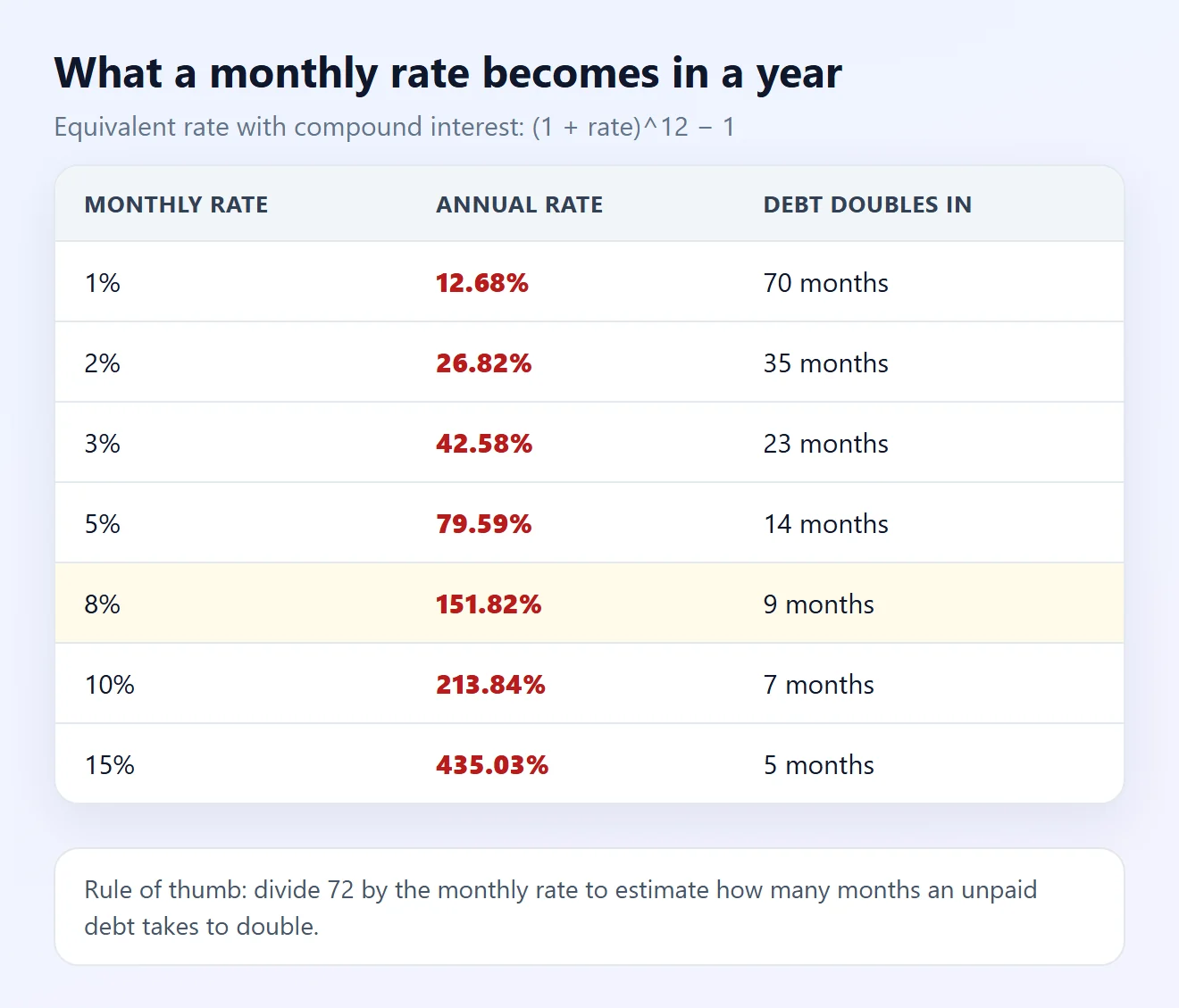
Monthly rates are misleading: 8% a month is not 96% a year. With compound interest the math is:
annual rate = (1 + monthly rate)^12 − 1
8% a month → 1.08^12 − 1 = 151.82% a year
- Rule of 72: divide 72 by the monthly rate to estimate how many months an unpaid debt takes to double. At 8% a month, about 9 months.
- Compare your rates with the market average on the Central Bank's Interest Rates page.
4Use the Central Bank's Citizen's Calculator
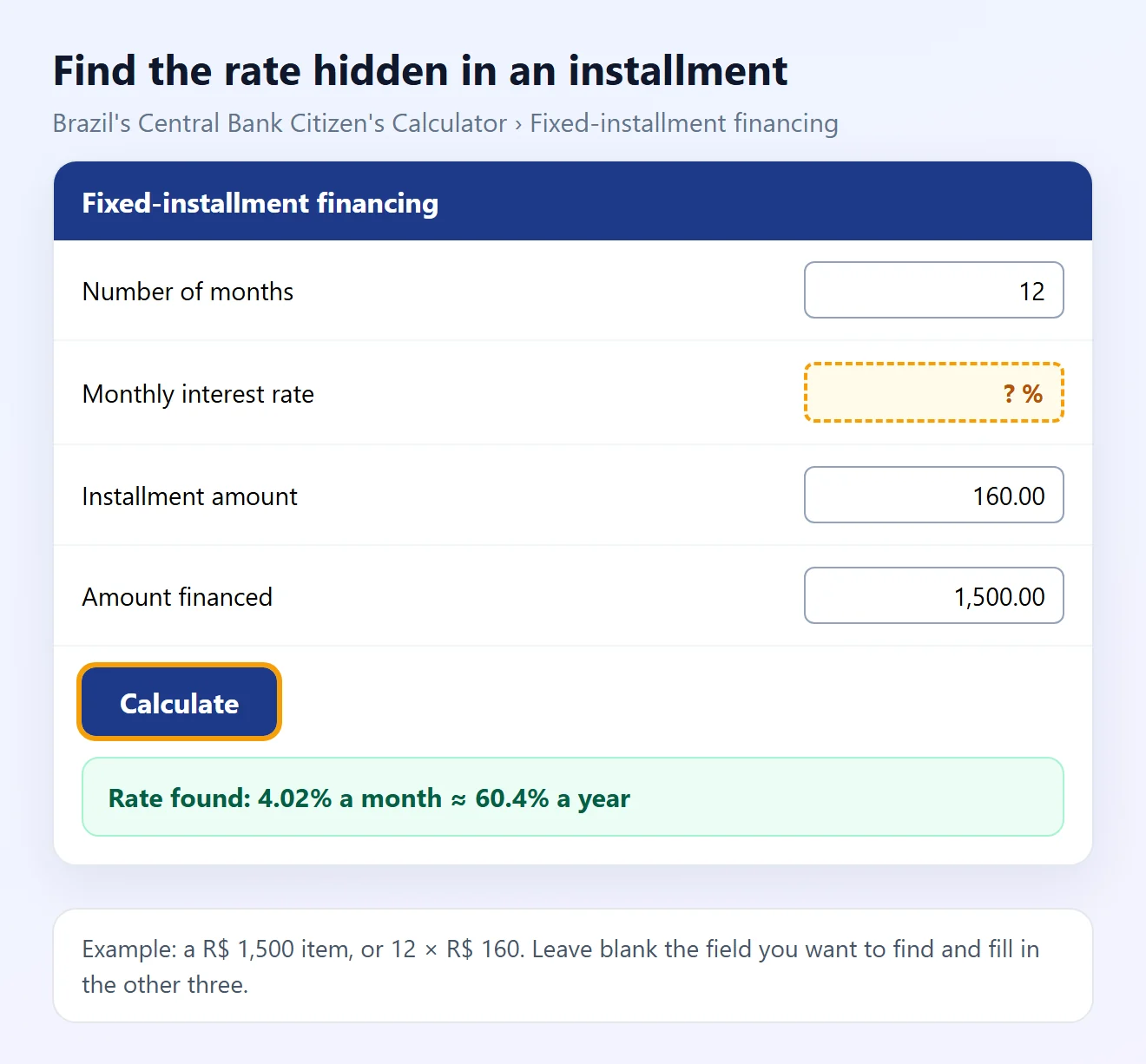
Only know the installment amount? The Central Bank's free calculator (in Portuguese) finds the hidden rate:
- Open the Calculadora do Cidadão and choose Financiamento com prestações fixas (fixed-installment financing).
- Fill in three fields: number of months, installment amount and amount financed (the cash price).
- Leave the monthly interest rate blank and click Calcular.
Example: R$ 1,500 cash or 12 × R$ 160 gives 4.02% a month, about 60% a year. “Interest-free” isn't always interest-free.
5Pay the most expensive debt first
- List every debt with its balance, installment and monthly rate. The Central Bank's Registrato shows your debts at every bank for free.
- Keep paying the required minimum on all of them so none falls behind.
- Put every extra real into the debt with the highest interest. When it's gone, move to the next one.
The revolving credit card balance and the overdraft are usually among the most expensive kinds of credit. See how to get out of your overdraft.
6Don't pay just the minimum or just the interest
- If you only pay the month's interest, the balance doesn't go down. If you pay less than the interest, the debt grows even though you're paying.
- Paying only the bill's minimum leaves the rest as a revolving balance, which compounds again the next month.
- Pay as much as you can above the minimum. Every extra real stops earning interest in the months ahead.
7Credit card debt: know the 100% cap
Since 2024, Law 14,690/2023 (art. 28) and CMN Resolution 5,112/2023 protect people with revolving or bill-installment debt:
- The interest and charges on these debts, added together, can't exceed 100% of the original debt.
- The bill must show the original amount and the charges separately.
- You can ask to renegotiate the balance at any time, within the same 100% cap.
Example: an original revolving debt of R$ 2,000 can reach at most R$ 4,000 with interest and charges. Charged more? Complain to the bank and, if that fails, to the Central Bank.
8Pay installments early and get an interest discount
The CDC (art. 52, § 2) guarantees early repayment, in full or in part, with a proportional reduction of interest and other charges.
- Example: a R$ 5,000 loan at 3% a month in 24 installments of R$ 295.24. Halfway through, 12 installments are left, or R$ 3,542.88 if paid on schedule.
- Paying it all off at once, the balance is about R$ 2,938.79: a saving of over R$ 600.
- For partial early payment, prefer paying off the last installments, which carry the most interest to discount.
Ask the bank for the early payoff amount in the app or by phone and check that the discount was applied.
9Swap for cheaper credit
- Compare on the Central Bank's Interest Rates page what each bank charges for each type of credit. Payroll loans (consignado) are usually cheaper than personal loans, credit cards and overdrafts.
- Use credit portability: another bank can take over your debt at a lower rate. Since CMN Resolution 5,112, this also covers credit card and overdraft balances.
- Always compare the CET, not just the rate, and use the new credit only to pay off the expensive debt.
Full walkthrough in how to refinance a debt.
10Behind on payments? Know the late-fee cap and negotiate
- Under the CDC (art. 52, § 1), the late fee on consumer credit can't exceed 2% of the installment. Late-payment interest is charged on top.
- Contact the bank as soon as possible and ask for a written offer with the total amount and the CET. See how to negotiate debt with your bank.
- Bank won't help? File a complaint at consumidor.gov.br or with the Central Bank.
- If your debts don't fit your income even after cutting costs, read about the over-indebtedness law.
Be wary of anyone promising to “clean up” your debts for an upfront fee. Negotiate only through your bank's official channels.
Situation and what to do
| Situation | Risk | What to do |
|---|---|---|
| I don't know my rate | Medium | Contract, CET and Citizen's Calculator (steps 2 and 4) |
| I only pay the card minimum | High | Pay above the minimum and renegotiate (steps 6 and 7) |
| Several debts at once | High | List them and pay the priciest first (step 5) |
| I have some extra money | Low | Pay installments early with a discount (step 8) |
| Rate above the market average | High | Portability or cheaper credit (step 9) |
| Installments overdue | Very high | Negotiate and, if needed, over-indebtedness law (step 10) |
Frequently asked questions
What is compound interest on a debt?
It's interest charged on a balance that already includes the previous months' interest. That's why an unpaid debt grows faster and faster.
What's the difference between simple and compound interest?
Simple interest always applies to the original amount. Compound interest applies to the updated balance. R$ 1,000 at 10% a month becomes R$ 2,200 in a year with simple interest and R$ 3,138 with compound interest.
How do I convert a monthly rate into an annual rate?
Use (1 + monthly rate)^12 − 1. For example, 3% a month equals 42.58% a year, and 8% a month equals 151.82% a year.
How do I find the interest on an installment purchase?
In the Central Bank's Citizen's Calculator, under fixed-installment financing, enter the number of months, the installment amount and the cash price, leave the rate blank and click Calcular.
Is credit card interest capped?
Yes, in Brazil. Under Law 14,690/2023, interest and charges on revolving and bill-installment debt, added together, can't exceed 100% of the original debt.
Do I get a discount if I pay my debt early?
Yes. Brazil's Consumer Defense Code (art. 52, § 2) guarantees a proportional interest reduction for full or partial early repayment.
What is the maximum late fee?
On consumer credit, the late fee can't exceed 2% of the installment (CDC, art. 52, § 1). Late-payment interest is charged separately.
What is the CET?
It's the total effective cost: the rate that adds up the credit's interest, fees, insurance and taxes. It's the best number for comparing offers.
Which debt should I pay first?
The one with the highest interest, while keeping the minimum on the others up to date. Revolving credit card and overdraft usually come before loans and financing.
Can I move my debt to another bank?
Yes, through credit portability. The new bank pays off the old debt and you pay the new bank, at what should be a lower rate. Since CMN Resolution 5,112, this also covers credit card and overdraft balances.
Related content
More practical solutions in Debt.
How to Get Out of Debt: A Complete Guide to Reorganizing Your Finances
Learn how to sair of the debts with estratégias práticas of organization financial, negotiation of débitos, control of expenses and planning for recuperar your estabilidade financial.
 30 minutes
Negative Credit Record in Brazil: How to Check and Resolve Outstanding Debts
Learn how to check for a negative credit record in Brazil, identify outstanding debts, negotiate with creditors, and track the regularization of your CPF safely.
15 minutes
How to negotiate debt with a bank
Learn how to negotiate debt with a bank safely, compare offers, reduce interest, and organize installments without compromising your budget.
15 minutes
Sources
- Planalto: Consumer Defense Code, Law 8,078/1990, art. 52 (in Portuguese)
- Planalto: Law 14,690/2023, art. 28, credit card interest cap (in Portuguese)
- Central Bank of Brazil: CMN Resolution 5,112/2023, credit cards and portability (in Portuguese)
- Central Bank of Brazil: Citizen's Calculator (in Portuguese)
- Central Bank of Brazil: Interest rates by type of credit and bank
- Central Bank of Brazil: Registrato
The charts, table and calculator screen in this guide are illustrations created by Fixfy. The simulations exclude IOF tax, fees and insurance. This content is for information only and doesn't replace a review of your contract.