

 Debt
 10 steps
Quick answer: in full or in installments?
- Pay in full when there's a discount and you have the money without touching your emergency fund.
- Always compare the total paid: add up every installment and see how much it exceeds the lump-sum price.
- Work out the interest built into the installments. If it's higher than what your savings earn, paying in full wins.
- Pay in installments when you don't have the money, when there's truly no interest, or when paying in full would wipe out your emergency fund.
- Chose installments? You can pay them early later, with less interest and no fee.
This guide follows Brazilian rules and examples in reais. The math works the same anywhere.
Which case is yours?
Pay debt in full or in installments: 10 steps to decide
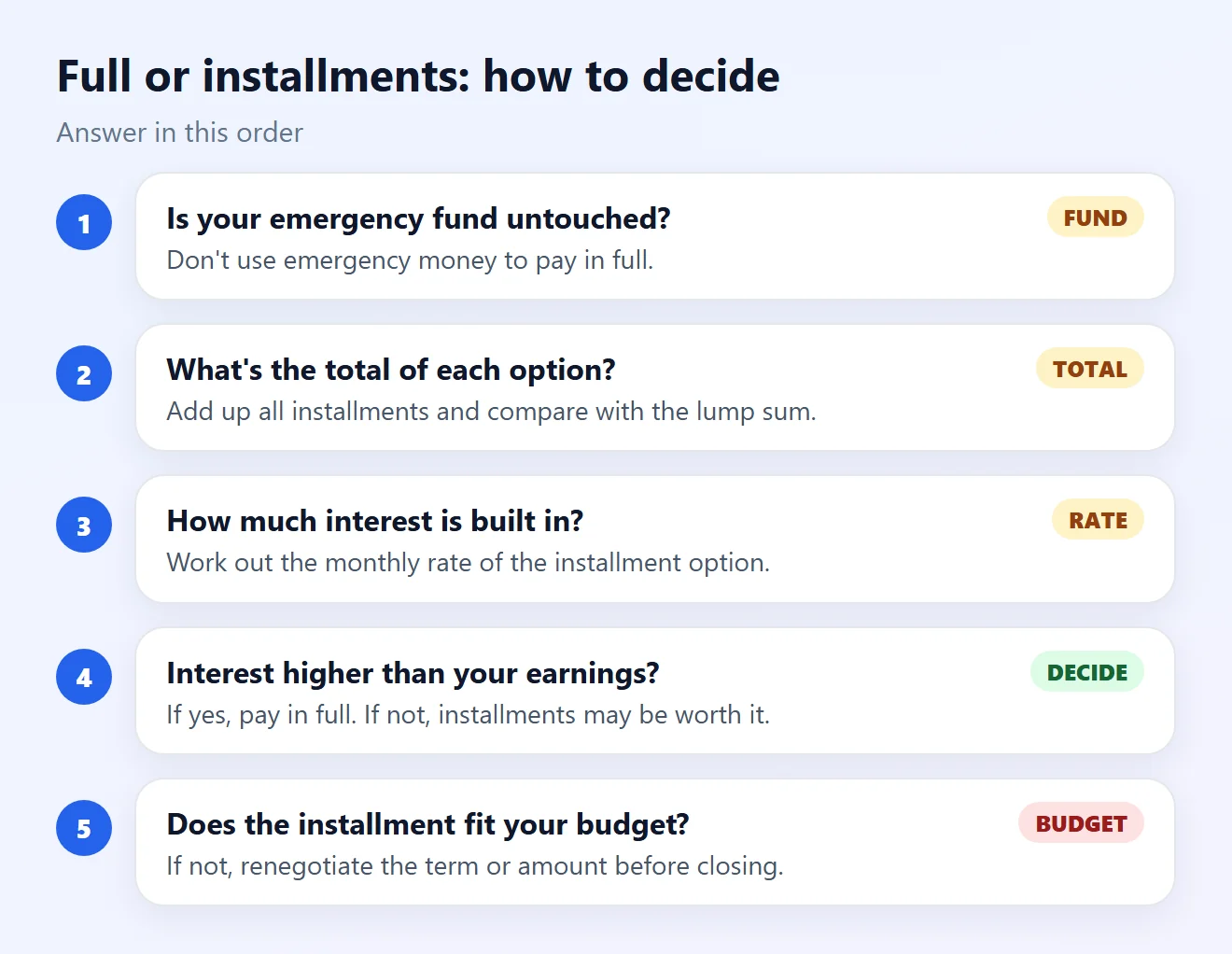
1Protect your emergency fund
- First, set aside your emergency money (usually a few months of essential expenses).
- Only use what's left beyond the reserve to pay in full. Emptying the reserve and facing a surprise expense next month can push you into an overdraft or revolving credit card debt, which cost far more.
- No reserve at all? A small installment that fits your budget may be safer than a single payment.
2Ask for both offers in full
Under Brazil's Consumer Protection Code (CDC, art. 52), anyone selling on credit or lending must tell you beforehand:
- the lump-sum price;
- the late-payment interest and the effective annual interest rate;
- the number and frequency of installments;
- the total to pay, with and without financing.
For bank loans and settlements, also ask for the CET (Custo Efetivo Total, total effective cost), which the bank must give you before you sign. And always ask: what's the discount for paying in full? Charging different prices by term or payment method is allowed by Law 13,455/2017, and the discount must be clearly displayed.
3Compare the total paid
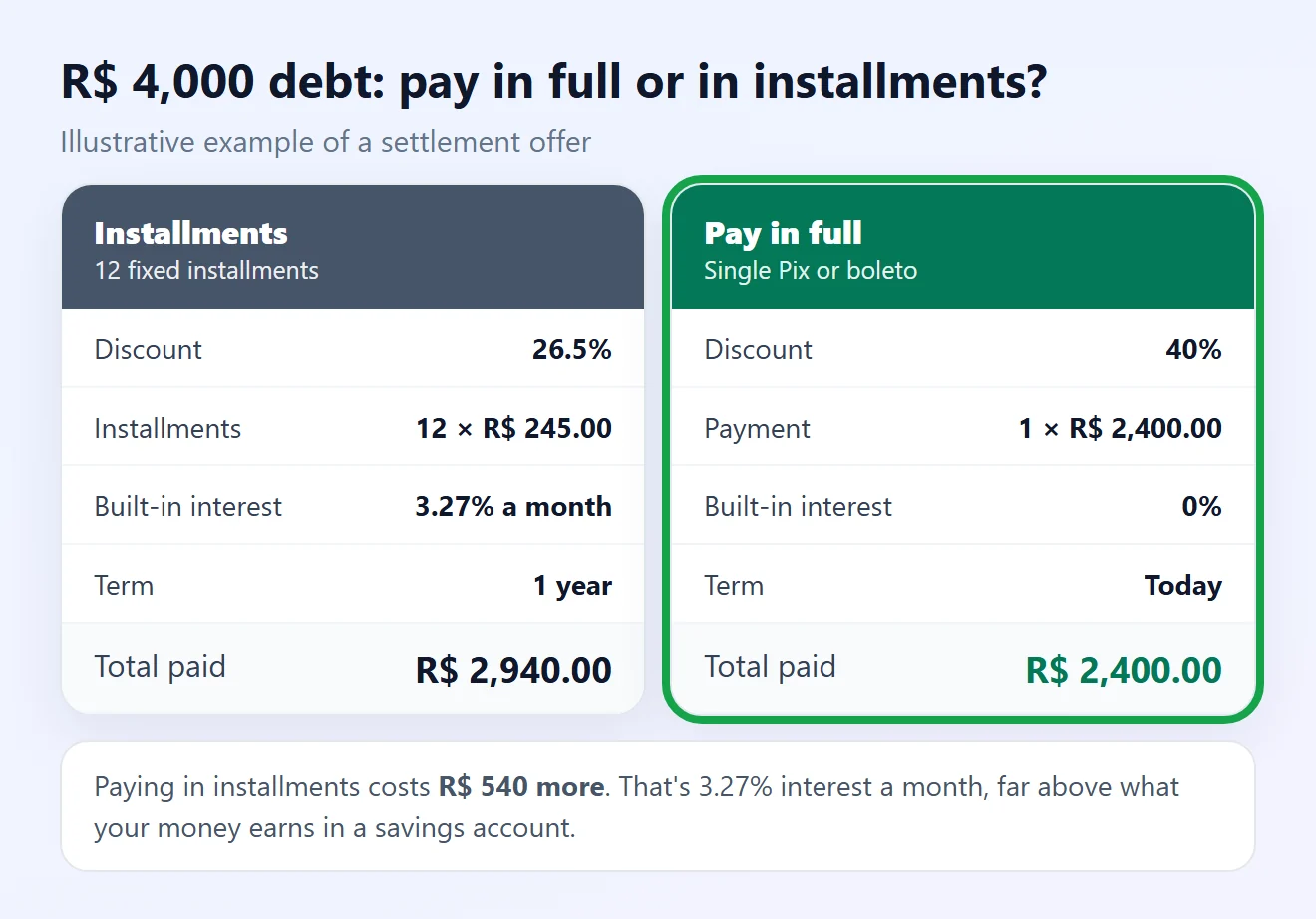
- Multiply the installment by the number of installments and add any down payment.
- Subtract the lump-sum price. The difference is what installments cost you.
- In the example, installments cost R$ 540 more (R$ 2,940 vs R$ 2,400).
4Work out the interest built into the installments
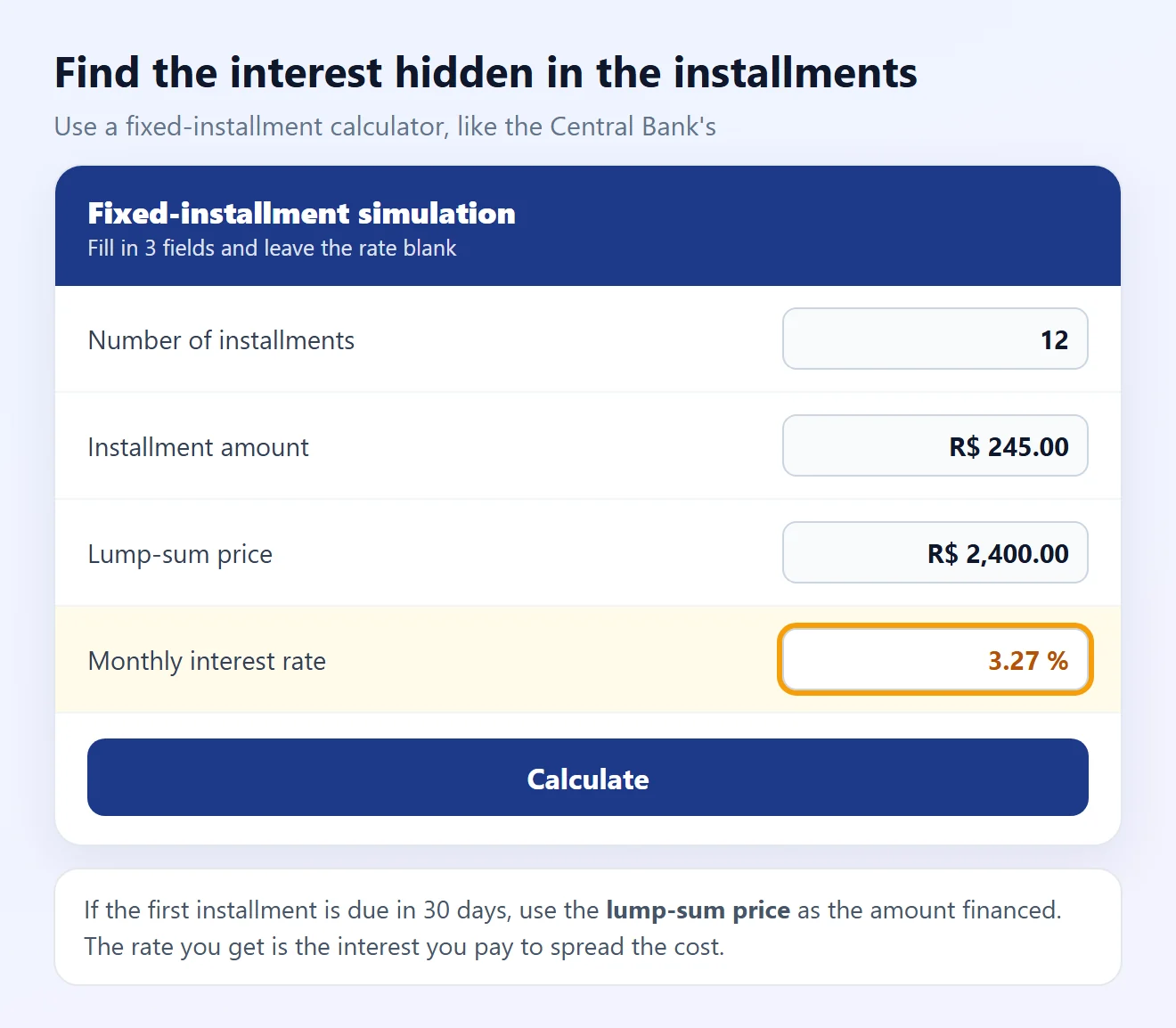
The difference in reais isn't enough: R$ 540 over 12 months isn't the same as R$ 540 over 36. To compare, find the monthly rate:
- Open the Central Bank's Calculadora do Cidadão (Citizen's Calculator), option Financiamento com prestações fixas (fixed-installment financing).
- Enter the number of months, the installment amount and, as the amount financed, the lump-sum price. Leave the rate blank.
- Click calculate. The result is the interest rate you pay to spread the cost.
In the example, 12 × R$ 245 against R$ 2,400 up front gives about 3.27% a month, or 47% a year. The calculator assumes the first installment is due in 30 days. If it's due today, the real rate is even higher.
5Compare with what your money earns
If you have the money, the question is: does it earn more saved than the installments cost?
- Brazil's savings account (poupança) pays the TR rate plus 0.5% a month while the Selic target is above 8.5% a year (below that, 70% of Selic plus TR), according to the Central Bank.
- Built-in interest higher than your earnings: pay in full.
- Built-in interest lower than your earnings (or zero): paying in installments and keeping the money invested may pay off, as long as you don't spend it.
In overdue debt settlements, built-in interest is almost always far above savings returns, like the 3.27% a month in the example.
6When to pay in full
- The lump-sum discount is large, as often happens with old, overdue debts.
- The interest built into the installments is higher than what your money earns.
- You can pay without touching the reserve or taking on other expensive credit.
- The debt is damaging your credit record and settling it all speeds up removal.
Negotiating with a bank? See how to negotiate debt with a bank.
7When installments make sense
- You don't have the money without using your reserve or borrowing.
- The installments are truly interest-free: the installment total equals the lump-sum price.
- The built-in interest is lower than what your savings earn.
If you go with installments, pick the shortest term with an installment that fits your budget. A longer term lowers the installment but raises the total.
Watch out for late payments: under the CDC (art. 52, § 1), the late fee can't exceed 2% of the installment, but late interest still applies. In settlements, paying late can cancel the discount.
8Check whether “interest-free” is real
- Ask for the price by Pix or cash. If it's lower than the installment total, there's interest built into the “interest-free” offer.
- Example: R$ 1,900 by Pix or 10 × R$ 200 on a card (R$ 2,000). The built-in interest is about 0.94% a month.
- Here the gap is small. Paying in full is worth it if you have spare money; installments make sense if you need to keep your reserve.
9Chose installments? Pay early when you have spare money
- The CDC (art. 52, § 2) guarantees early repayment, in full or in part, with a proportional cut in interest.
- For bank credit contracts, CMN Resolution 3,516 bans fees for early settlement.
- Pay the last installments first: they carry the most built-in interest. Ask for the discounted amount in the app or customer service.
10Several debts? Start with the most expensive
- Use lump-sum money first on the highest-interest debt, such as revolving credit card debt and the overdraft.
- Don't take an expensive loan to pay a cheap debt in full.
- Swapping several expensive debts for one cheaper debt can help: see how to refinance a debt.
Learn why debt grows so fast in compound interest on debt.
Situation and what to do
| Situation | Best choice | Step |
|---|---|---|
| Big discount and money beyond the reserve | Pay in full | 6 |
| Only emergency money available | Shortest affordable installments | 1 and 7 |
| Interest-free with the same lump-sum price | Installments, keep the money invested | 8 |
| Built-in interest above your earnings | Pay in full | 4 and 5 |
| Already in installments, with spare money | Pay the last installments early | 9 |
| Several debts | Pay the highest-interest one first | 10 |
Frequently asked questions
Is it better to pay debt in full or in installments?
Paying in full is better when there's a discount and you have the money without using your emergency fund. Installments make sense when there's truly no interest, when the built-in interest is lower than your savings earn, or when paying in full would empty your reserve.
How do I work out the interest on installments?
Use the Brazilian Central Bank's Calculadora do Cidadão, option Financiamento com prestações fixas. Enter the number of months, the installment amount and the lump-sum price as the amount financed, and leave the rate blank.
Should I use my emergency fund to pay in full?
Generally, don't use all of it. A surprise expense afterwards can push you into an overdraft or revolving credit card debt, which cost far more than the discount you got.
Can a store charge different prices for cash and installments?
Yes. Brazil's Law 13,455/2017 allows different prices depending on the term or payment method, and the seller must clearly display the discounts.
What must the company tell me before I choose installments?
Under the CDC (art. 52): the lump-sum price, late-payment interest, the effective annual rate, the number and frequency of installments and the total to pay with and without financing.
Can I pay off installments early and pay less?
Yes. The CDC (art. 52, § 2) guarantees a proportional cut in interest for full or partial early repayment. Banks can't charge a fee for it.
Are interest-free installments always a good deal?
Only if the installment total equals the lump-sum price. If there's a Pix or cash discount, interest is built in. Compare the total and work out the rate.
What's the maximum late fee on an installment?
For consumer purchases and credit in Brazil, the late fee can't exceed 2% of the installment (CDC, art. 52, § 1). Late interest is charged separately.
How much does a savings account earn, for comparison?
According to Brazil's Central Bank, the poupança pays TR plus 0.5% a month while the Selic target is above 8.5% a year. With Selic at or below that, it pays 70% of Selic plus TR.
I have several debts. Which should I pay in full first?
The one with the highest interest, usually revolving credit card debt and the overdraft. Then negotiate the others with a discount.
Related content
More practical solutions in Debt.
Compound Interest on Debt: How to Understand and Prevent Balance Growth
Entenda how to the compound interest aumentam the amount of a debt to the longo of the time, how to identify the encargos cobrados and quais atitudes helpm the reducesir the impact financial.
 15 minutes
How to Get Out of Debt: A Complete Guide to Reorganizing Your Finances
Learn how to sair of the debts with estratégias práticas of organization financial, negotiation of débitos, control of expenses and planning for recuperar your estabilidade financial.
30 minutes
Negative Credit Record in Brazil: How to Check and Resolve Outstanding Debts
Learn how to check for a negative credit record in Brazil, identify outstanding debts, negotiate with creditors, and track the regularization of your CPF safely.
15 minutes
Sources
- Planalto: Consumer Protection Code, Law 8,078/1990, art. 52 (in Portuguese)
- Planalto: Law 13,455/2017 on prices by term or payment method (in Portuguese)
- Central Bank of Brazil: Citizen's Calculator, fixed-installment financing (in Portuguese)
- Central Bank of Brazil: savings account returns (in Portuguese)
- Central Bank of Brazil: CMN Resolution 4,881/2020 on total effective cost (in Portuguese)
- Central Bank of Brazil: CMN Resolution 3,516/2007 on early settlement (in Portuguese)
The screens and examples in this guide are illustrations made by Fixfy, with example amounts. Rates were calculated with fixed installments and the first installment due in 30 days. This content is for information only and isn't investment advice.