

 Credit card
 10 steps
Quick answer: what to do when your credit card bill is too high
- Before paying, check every charge. A purchase you don't recognize: block the card in the app and dispute it.
- Look for double charges, subscriptions, insurance and fees you didn't sign up for, and ask for a refund.
- Add up the installments still to come: they're often the biggest part of the bill.
- Purchases abroad pay 3.5% IOF and are converted at the exchange rate on the day of each purchase.
- Can't pay it all? Pay as much as you can and compare the bill's own installment options.
What's your case?
High credit card bill: 10 steps to understand it and lower it
1Compare it with last month's bill
- Open the full bill in the card's app or website, not just the total.
- Since July 2024, Brazilian card bills have a highlight area with the total, due date and limit, and an area with payment options.
- Put it next to last month's bill and note what's new: purchases, installments, fees, interest or charges.
2Look for purchases you don't recognize
- Search the store name: many show up on the bill under the company's legal name, not the brand.
- Ask anyone with an additional card, and check apps and stores where your card is saved.
- Still don't recognize it? Block the card in the app, dispute the purchase and ask for a new card.
- For online shopping, use a virtual card you can delete later.
3Dispute double or undue charges
- Same store, same amount, same date? It may be a duplicate charge. Dispute it in the app or by phone and write down the ticket number.
- Under Brazil's Consumer Protection Code, if you paid an undue charge you're entitled to double the amount overpaid, with adjustment and interest, unless it was a justifiable error.
- No solution? File a complaint on consumidor.gov.br or with Procon.
4Add up the installments still to come
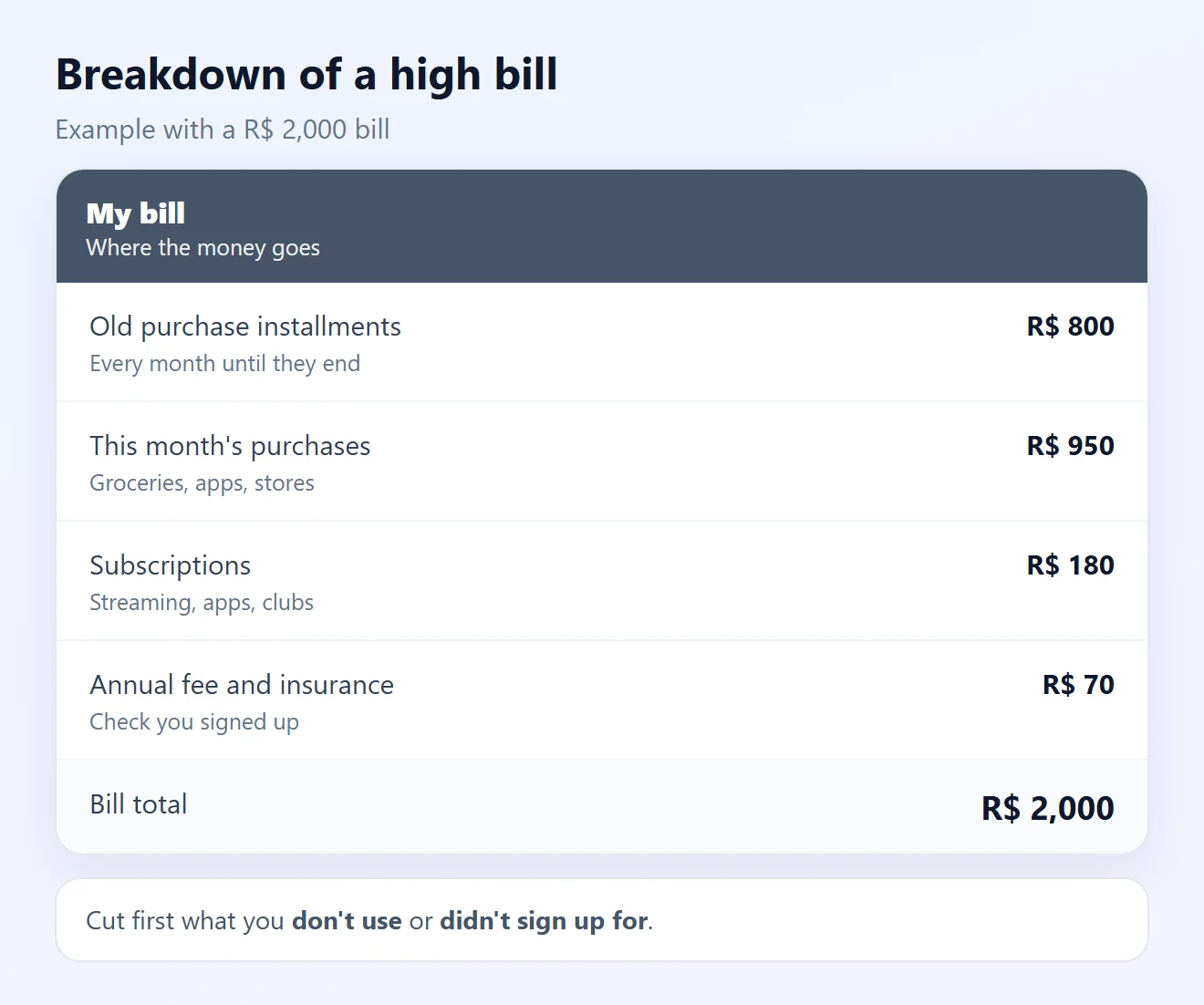
- Installments from old purchases show up every month until they end and add up with new purchases.
- List each installment plan with its amount and how many payments are left. The bill also shows future charges.
- While the bill is high, avoid splitting new purchases into installments.
5Cut subscriptions you don't use
- Look for small, repeated charges: streaming, apps, storage, clubs and free trials that turned into charges.
- Cancel through the service itself or the app store (Google Play or App Store), not just on the card.
6Check the annual fee and other fees
- National Monetary Council rules allow credit cards to charge an annual fee and fees for specific services: card replacement, cash withdrawal, paying bills with the card and emergency credit assessment.
- The annual fee can be charged only once every 12 months (it may be split). Emergency credit assessment, to spend above the limit, only at your request and at most once every 30 days.
- Card fee increases must be announced 45 days in advance.
- Annual fee too high? Ask for a discount or waiver, or switch to a no-annual-fee card.
7Cancel insurance and services you didn't ask for
- Look for items like "seguro" (insurance), "proteção", "assistência" or "clube" on the bill.
- Under the Consumer Protection Code, a service provided without your request counts as a free sample: you don't have to pay for it.
- Ask for cancellation and a refund through customer service and keep the ticket number.
8Understand purchases abroad
- Purchases from foreign websites and stores pay 3.5% IOF (financial transactions tax).
- For each purchase, the bill must show the amount in the foreign currency, the amount in US dollars and the rate on the purchase date, and the amount in reais.
- Check that the amount in reais matches. Unexplained difference? Dispute it.
9Can't pay it all? Pay as much as you can
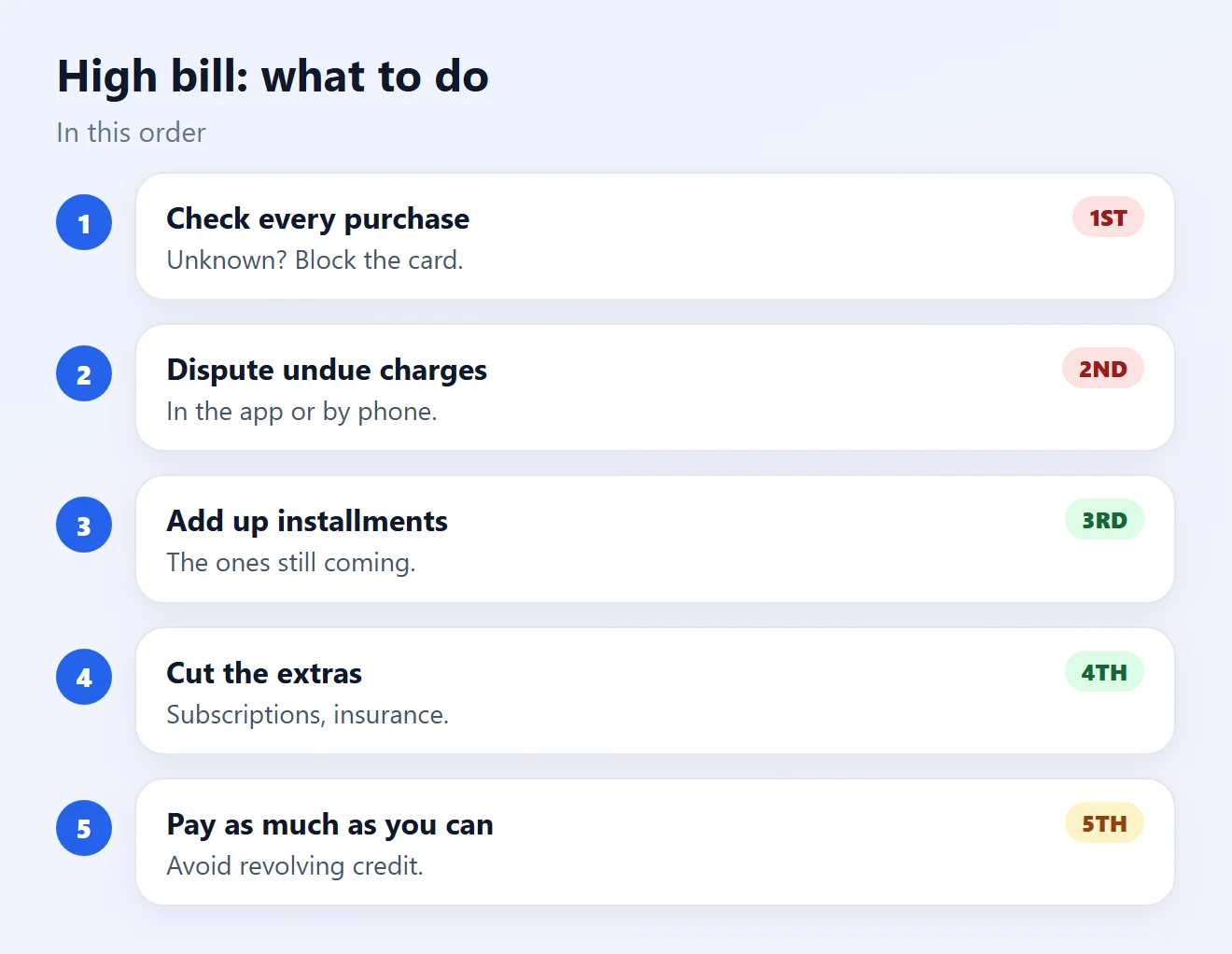
- What you don't pay goes into revolving credit, which can only last until the next bill and has high interest.
- Pay more than the minimum and compare the bill's installment options by total cost.
- Interest and charges on revolving credit and bill installments are capped at 100% of the original debt.
10Avoid the next high bill
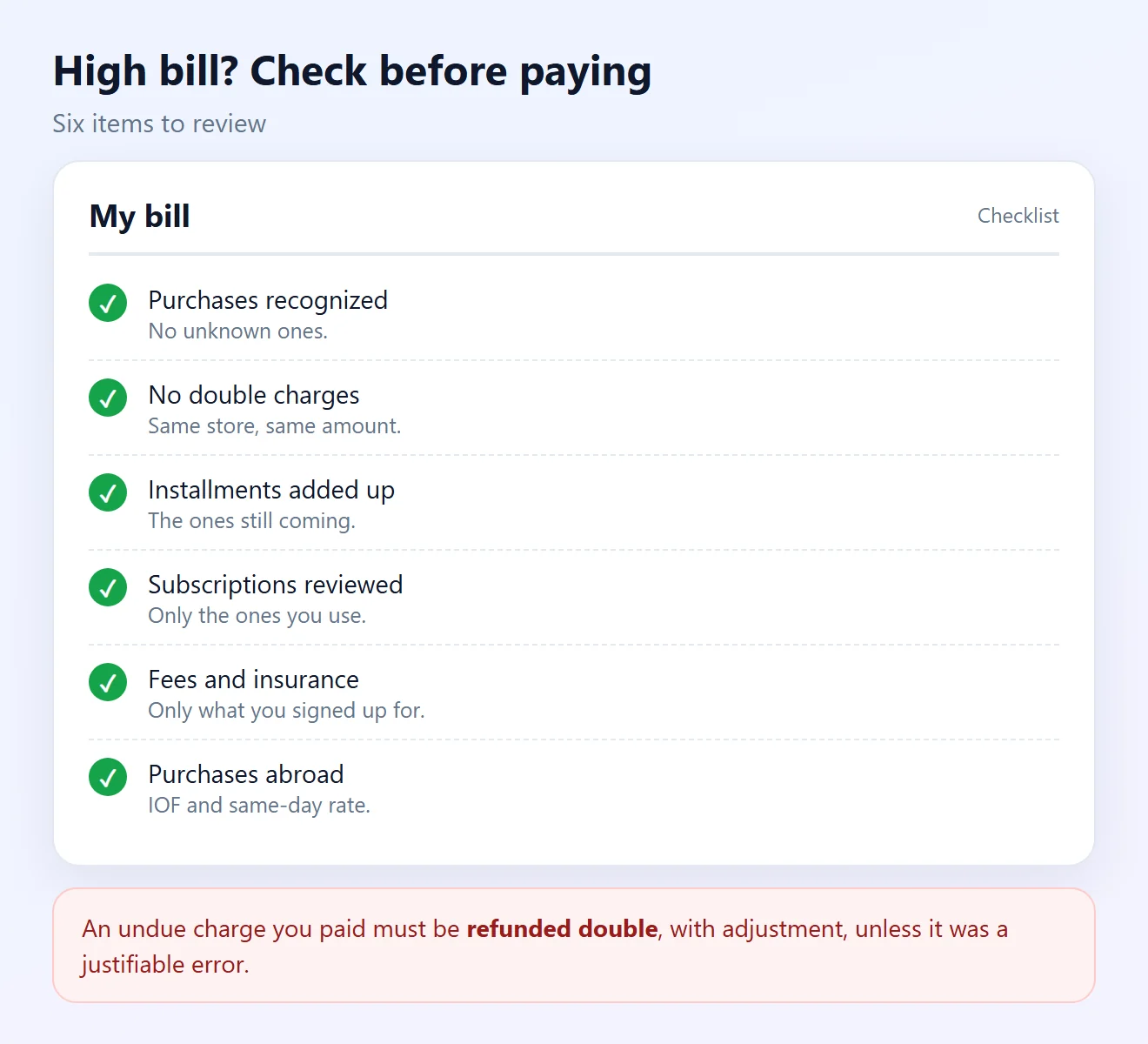
- Turn on purchase alerts in the app to see every charge right away.
- Set your limit to an amount you can pay in full.
- Track card spending in your monthly budget, not only when the bill arrives.
See how to adjust your card limit and how to track daily expenses.
Problem and fix
| Problem | Likely cause | Fix |
|---|---|---|
| Purchase I don't recognize | Different store name or fraud | Search, block and dispute (step 2) |
| Same purchase twice | Duplicate charge | Dispute and ask for a refund (step 3) |
| High bill every month | Piled-up installments | Add them up and stop splitting (step 4) |
| Small repeated charges | Forgotten subscriptions | Cancel in the service (step 5) |
| Insurance or fee I didn't ask for | Service not signed up for | Cancel and ask for a refund (steps 6 and 7) |
| Purchase abroad cost more | IOF and exchange rate | Check the conversion on the bill (step 8) |
Frequently asked questions
Why is my credit card bill so high?
The most common reasons are old purchase installments adding up with new ones, forgotten subscriptions, purchases abroad, interest from unpaid bills and charges you don't recognize.
What should I do about a purchase I don't recognize?
Search the store name and ask anyone with an additional card. If you still don't recognize it, block the card in the app, dispute the purchase and ask for a new card.
I was charged twice. What am I entitled to?
If you paid an undue charge, Brazil's Consumer Protection Code entitles you to double the amount overpaid, with adjustment and interest, unless it was a justifiable error.
Which fees can a credit card charge in Brazil?
An annual fee and fees for card replacement, cash withdrawal, paying bills with the card and emergency credit assessment, which can only be charged at your request.
Can the annual fee be charged more than once a year?
No. The annual fee is charged at most once every 12 months, but it can be split into monthly payments.
There's insurance I didn't sign up for. Do I have to pay?
No. Under the Consumer Protection Code, a service provided without a request counts as a free sample. Ask customer service to cancel it and refund you.
How much IOF do I pay on purchases abroad?
3.5% on card purchases from foreign stores and websites.
Which dollar rate applies to international purchases?
The rate on the date of each purchase. The bill must show the amount in dollars, the rate and the amount in reais for each one.
I can't pay the full bill. What should I do?
Pay as much as you can, above the minimum, and compare the bill's installment options by total cost. Avoid leaving the balance in revolving credit.
How do I avoid another high bill?
Turn on purchase alerts, set a limit you can pay, avoid installments and track card spending in your budget.
Related content
More practical solutions in Credit card.
Credit card debt: first steps
Learn how to lidar with debt in the card of credit, reduce interest, negociar with the administradora and recuperar the controle of the finanças without comprometer the budget.
 15 minutes
How to Use Your Credit Card Limit Without Getting Into Debt
Learn how to use your credit card limit responsibly, control spending, avoid debt, and keep your budget balanced.
Sources
- Consumer Protection Code, art. 39, III and sole paragraph, and art. 42, sole paragraph (in Portuguese)
- CMN Resolution 3,919/2010: credit card fees, consolidated text (in Portuguese)
- BCB Resolution 277/2022, art. 52: what the bill must show for purchases abroad (in Portuguese)
- Decree 12,499/2025: 3.5% IOF on card purchases abroad (in Portuguese)
- gov.br: interest cap, portability and the new card bill (in Portuguese)
- consumidor.gov.br: complaints against companies (in Portuguese)
The images on this page are illustrations created by Fixfy. Amounts are examples.