

 Financial budget
 10 steps
Quick answer: how to track daily expenses
- Write down every expense for 30 days, even coffee. Don't trust your memory.
- Sort expenses into needs, extras and waste.
- On payday, pay fixed bills and save first. What's left, divided by 4, is your weekly allowance.
- Spend the daily money by debit or Pix, ideally from a separate account.
- Do a 10-minute weekly review and cut one expense at a time.
What's your case?
How to track daily expenses: 10 steps
1Know how much really comes in each month
- Use your net income: what lands in your account after deductions, not your gross salary.
- Variable income? Use the average of recent months or your weakest month.
- Include fixed support (alimony, benefits) and leave out what isn't guaranteed, like the 13th salary and overtime.
2Write down every expense for 30 days
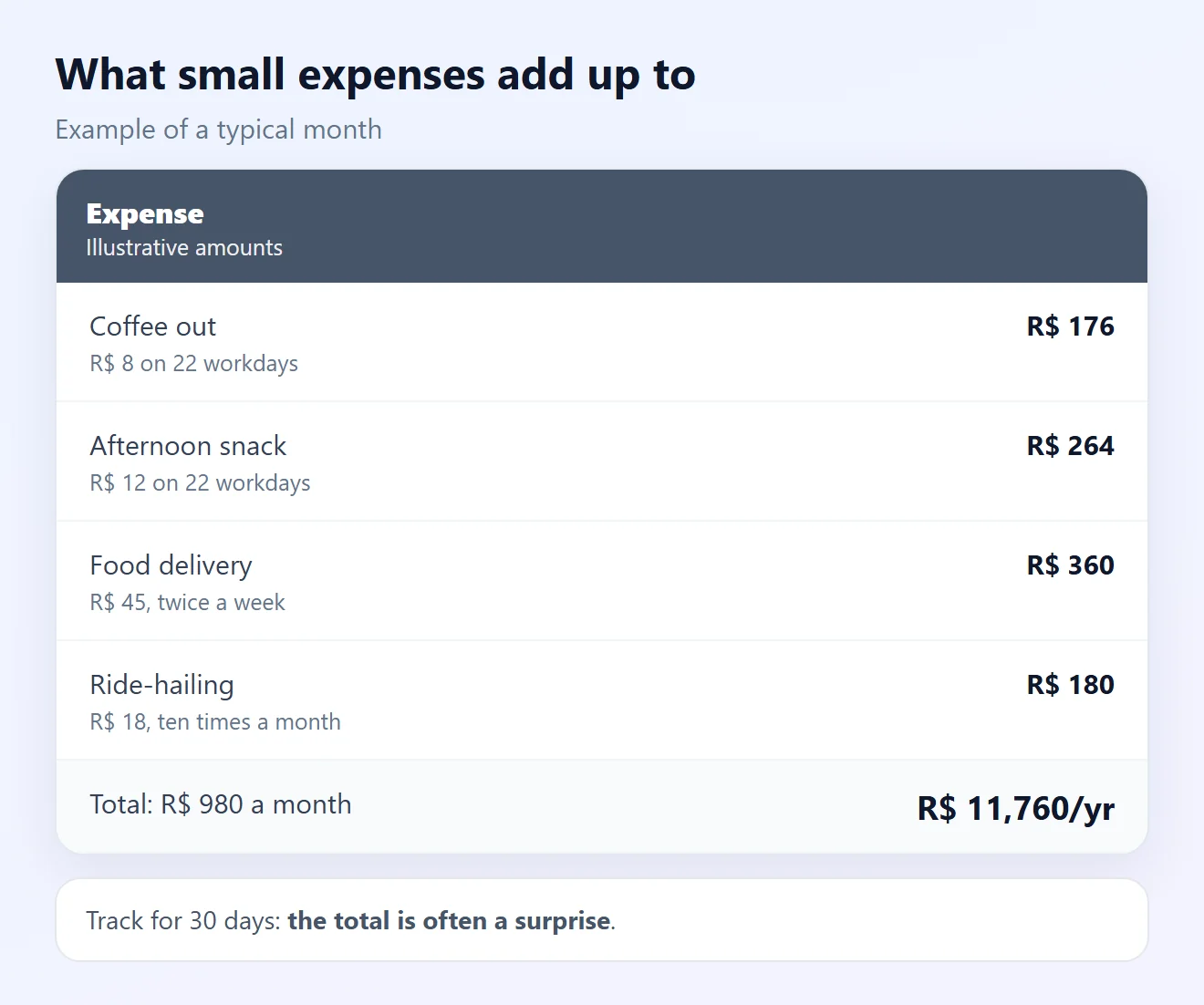
- Write it down right away: amount, what it was and how you paid. Brazil's Central Bank warns: don't rely on memory alone.
- Include small expenses: coffee, snacks, parking, delivery, rides. Added up, they're often a surprise.
- Paid in cash? Write that down too, since it doesn't show on your statement.
3Choose a simple tool
- Notebook or phone notes: the fastest way to start.
- Spreadsheet: adds up automatically and shows totals by category.
- Banking app: many already sort card and Pix spending by category.
- App that combines several accounts through Open Finance: you choose which data to share, with whom and for how long, and can cancel the authorization whenever you want.
4Sort into needs, extras and waste
- Needs: rent, water, power, groceries, transport. You can't cut them, but you can reduce them.
- Extras: snacks, delivery, movies, impulse buys. They can be reduced or cut.
- Waste: fines, interest, subscriptions you don't use. Eliminate them.
- This is the split Brazil's Central Bank suggests for building a budget.
5Set a weekly limit
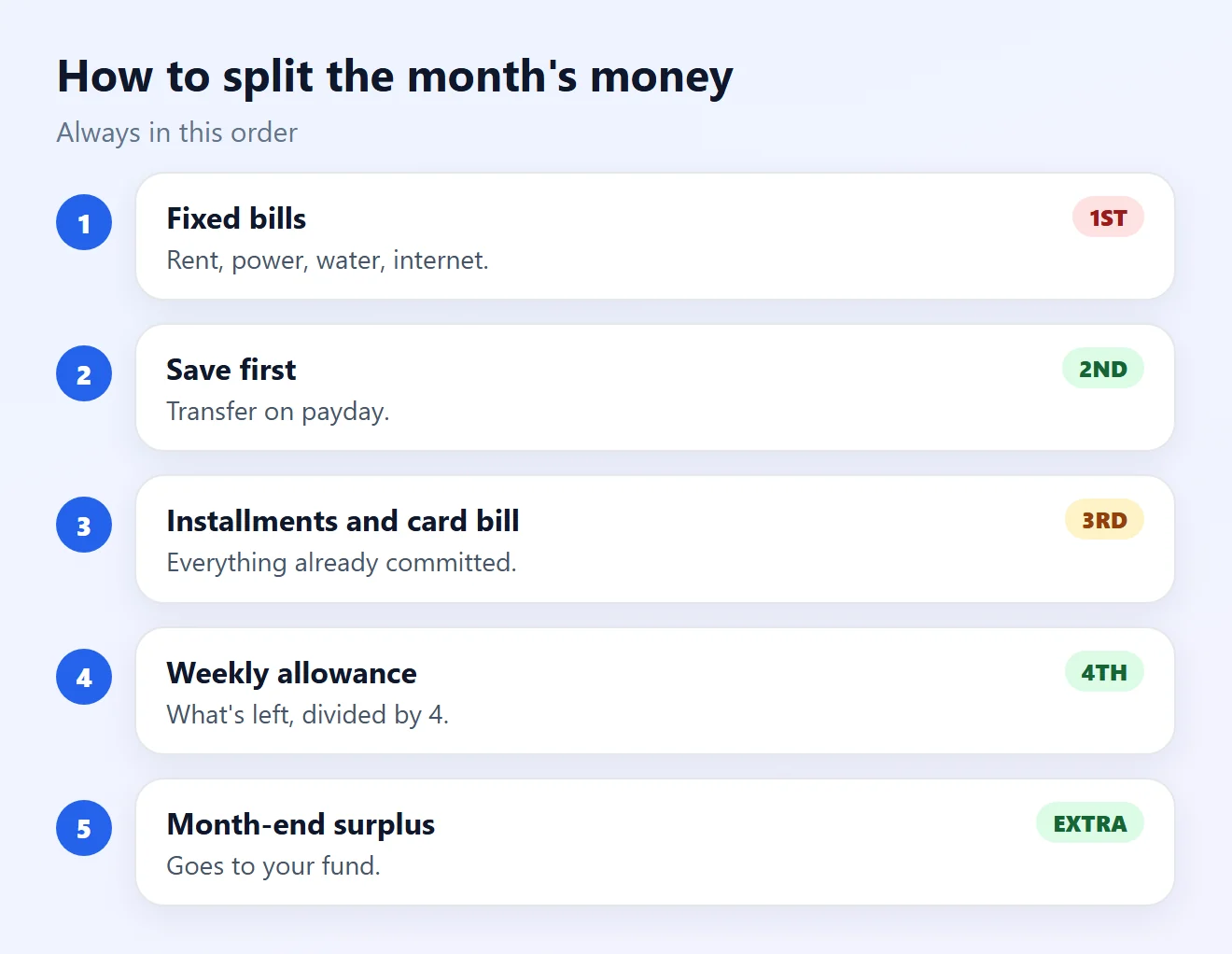
- From your income, take out fixed bills, the amount to save and existing installments.
- What's left is your day-to-day money. Divide it by 4 to get your weekly allowance.
- Example: R$ 3,000 income, R$ 1,600 fixed bills, R$ 300 to save and R$ 300 in installments. R$ 800 is left, or R$ 200 a week.
- A weekly limit works better than a monthly one: if you overspend, you notice in time.
6Pay yourself first
- As soon as your pay arrives, set aside the amount to save. Leaving it for month's end rarely works.
- Schedule a monthly automatic transfer to savings or a fund. Treat it as a fixed bill.
- Start small: what matters is building the habit.
7Use a separate account for daily spending
- Move the weekly allowance to a separate digital account or wallet. The balance shows how much you can still spend.
- Day to day, prefer debit or Pix: the money leaves right away and you feel the expense.
- If you use the credit card, write down each purchase and subtract it from the weekly allowance.
- Turn on your bank's purchase notifications to see each expense on your phone.
8Do a 10-minute review every week
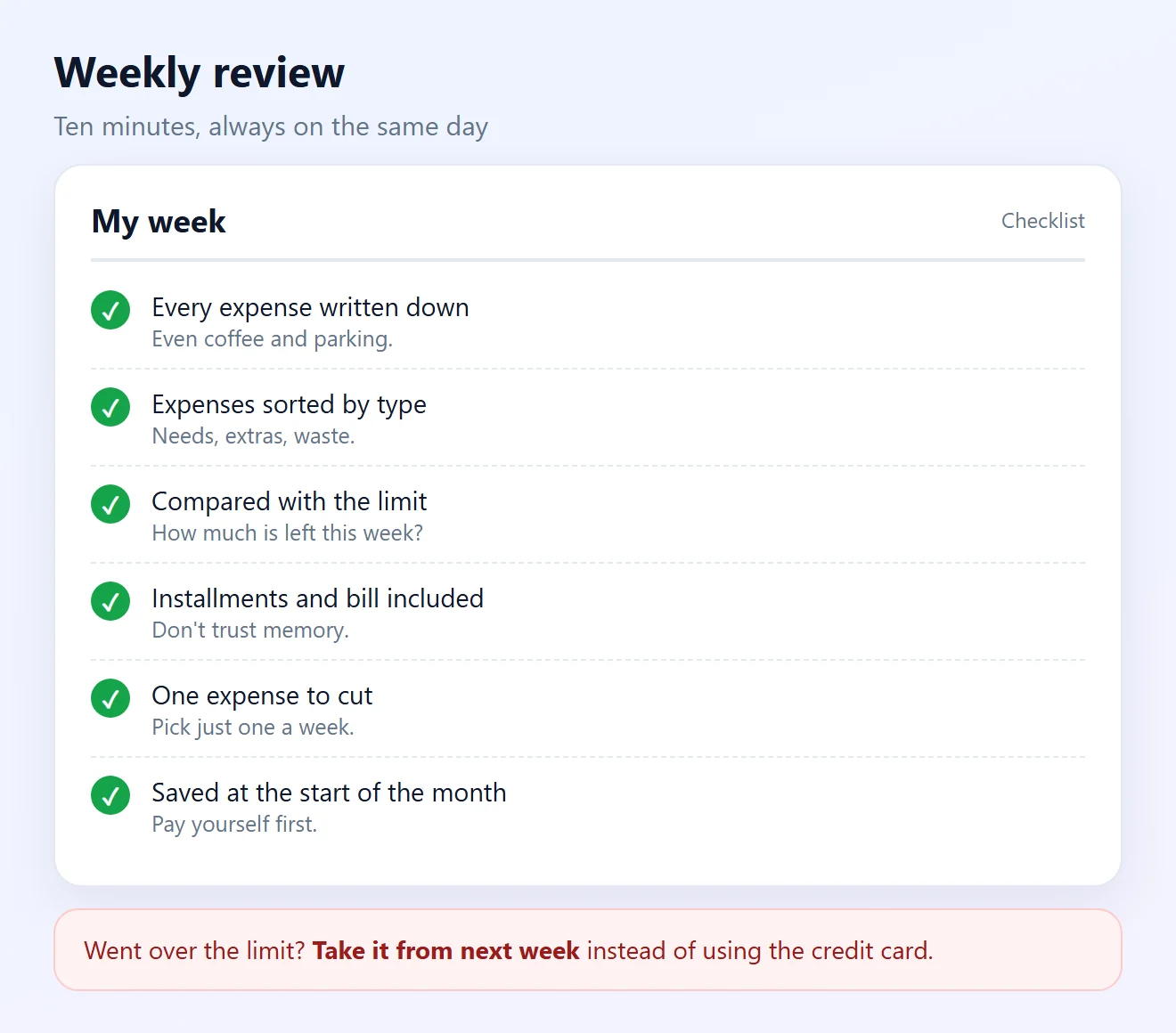
- Pick a fixed day, like Sunday evening, and compare what you spent with the weekly allowance.
- Overspent? Take it from next week instead of covering it with the credit card.
- Money left over? Send it to your fund or a goal.
9Cut one leak at a time
- Look at your notes and pick one extra a week to reduce, like delivery or snacks.
- Before buying something unplanned, wait 24 hours.
- Bring lunch and a water bottle, and shop for groceries with a list.
- Cancel the subscriptions you don't use.
See how to avoid impulse buying and how to cancel forgotten subscriptions.
10Include installments and the card bill
- Add up all existing installments and loans before working out your weekly allowance. As Brazil's Central Bank puts it, mental math tends to fail.
- Before splitting something new into installments, ask: do I need it? Do I need it now? Does it fit the budget comfortably?
- Always pay the full card bill. The minimum pushes the rest into revolving credit.
See when to pay in full or in installments and how to cut unnecessary expenses.
Situation and what to do
| Situation | Likely cause | What to do |
|---|---|---|
| Money disappears and I don't know where | Untracked small expenses | Write it all down for 30 days (step 2) |
| Short of money in the last week | No weekly limit | Divide the money by 4 (step 5) |
| Nothing left to save | Saving only what's left | Transfer on payday (step 6) |
| I give up tracking after a few days | Tool too complicated | Start with phone notes (step 3) |
| Lots of delivery and impulse buys | Unplanned spending | 24-hour rule (step 9) |
| Card bill higher than expected | Forgotten installments | Add up every installment (step 10) |
Frequently asked questions
What's the best way to track daily expenses?
Write down every expense right away, sort them by type and set a weekly allowance. The tool matters less than the habit.
How long should I track my expenses?
Start with 30 days to find out where your money goes. Then keep tracking to compare with your weekly limit.
Is an app, spreadsheet or notebook better?
Whatever you'll use every day. A notebook or phone notes are faster; spreadsheets and apps add up and sort by category.
Is it safe to use an app that combines my accounts?
With Open Finance, you choose which data to share, with which institution and for how long, and can cancel the authorization whenever you want. Always authorize through your bank's official app or website.
How do I work out how much I can spend each week?
From your net income, subtract fixed bills, the amount to save and installments. Divide what's left by 4.
What if I go over the weekly limit?
Take the excess from next week. Avoid covering the gap with the credit card or overdraft.
What are extras?
Expenses you can reduce or cut without harming essentials, like snacks, delivery and impulse buys.
How much should I save each month?
There's no right amount. Start with a small amount that fits your budget and save it as soon as you're paid, with an automatic transfer.
Does paying by debit help?
Yes, because the money leaves right away and the balance shows how much you can still spend. On credit, the expense only appears on the bill.
How do I track expenses on variable income?
Base your allowance on your weakest month or the average of recent months, and save the extra in good months.
Related content
More practical solutions in Financial budget.

How to Cancel Forgotten Subscriptions and Save Money
Find recurring subscriptions that may be consuming your budget and learn how to identify automatic charges and cancel services you no longer use.
 10 minutes
Credit Score: How It Works and What Influences Your Score
Understand what a credit score is, which factors may influence it, and how to maintain a more organized financial history.
10 minutes
How to Cut Unnecessary Expenses Without Giving Up Everything
Learn how to identify low-value spending, reduce waste, and save money without unnecessarily sacrificing your quality of life or essential needs.
30 minutes
Sources consulted
- Central Bank of Brazil: Starting adult life, knowing your expenses (in Portuguese)
- Central Bank of Brazil: Achieving dreams, budget and paying yourself first (in Portuguese)
- Central Bank of Brazil: Organizing family life, family budget (in Portuguese)
- Central Bank of Brazil: Open Finance (in Portuguese)
The images on this page are illustrations created by Fixfy. Amounts are examples.