

 Loans
 15 minutes
 10 steps
Quick answer: how to compare personal loans in Brazil
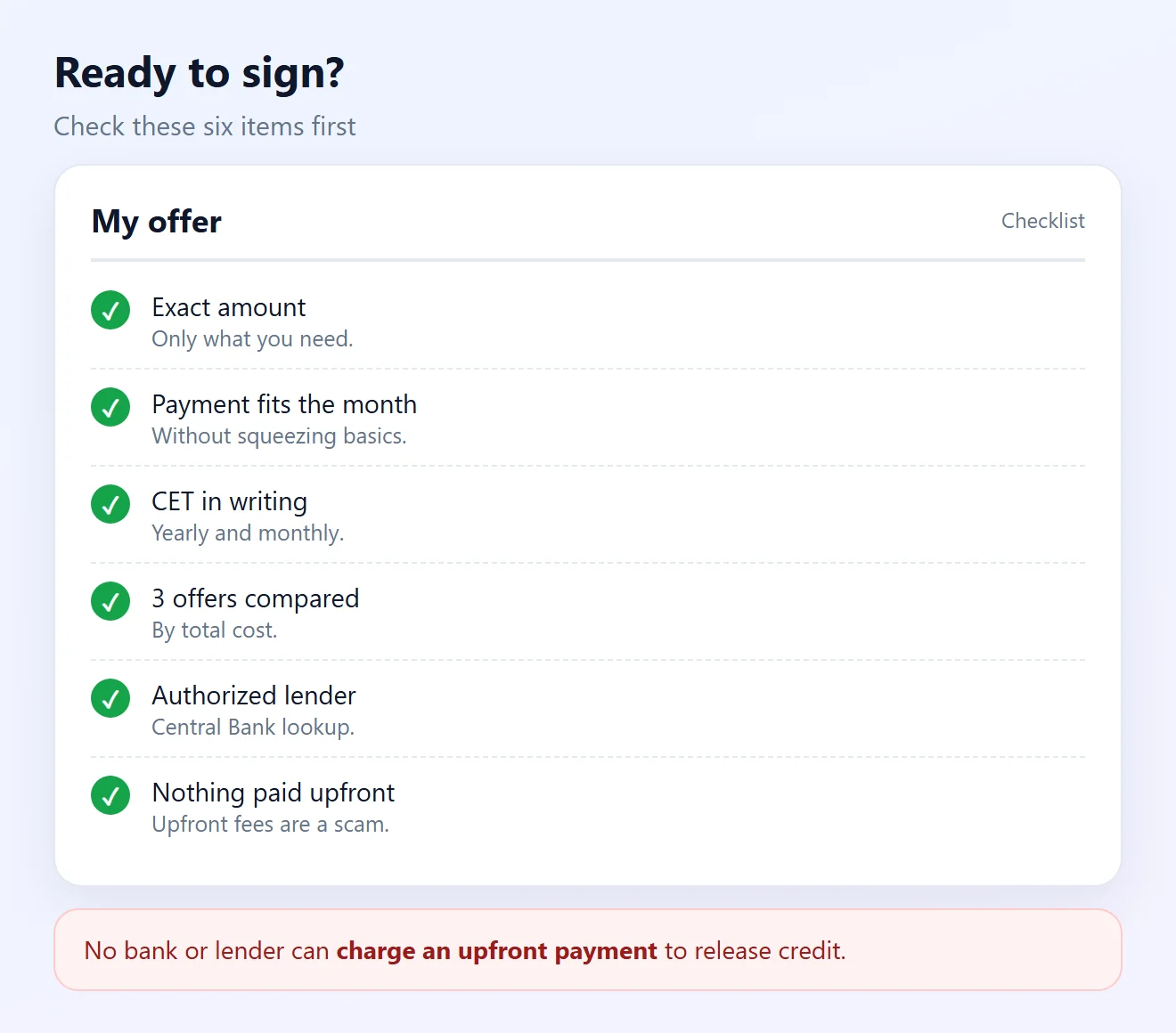
- Borrow only the amount you need and check that the installment fits your month without squeezing the basics.
- Demand the CET (total effective cost) in writing: the law requires lenders to disclose it before you sign.
- Compare at least 3 offers by total cost, not by installment. The gap can exceed R$ 3,000 on a R$ 5,000 loan.
- Check that the lender is authorized by the Central Bank and contact it through official channels.
- Never pay anything upfront to release credit: no bank or lender is allowed to charge that.
What's your case?
How to compare personal loan offers: 10 steps
1Decide how much you need and why
- Write down the exact amount and the reason. Borrowing more means paying interest on money you don't use.
- A personal loan has no collateral, so interest is usually higher than on payroll loans or secured credit.
- Using it to pay monthly bills only postpones the problem. Review your budget first.
If you have a formal job or an INSS benefit, also compare with a payroll loan.
2Use it to replace more expensive debt
- A good use is paying off overdraft or credit card revolving credit, which usually carry much higher interest.
- Compare the loan's CET with your current debt's interest. It's only worth it if it's cheaper overall.
- After swapping, don't use the limit again, or you'll end up with both debts.
3Check that the installment fits your month
- Add up your fixed bills and see what's left. The installment must fit with room to spare, even in months with extra expenses.
- A lower installment usually means a longer term and a higher total. Choose the shortest term that fits.
- Simulate on the Central Bank's Citizen's Calculator to check the installment, rate and term.
4Demand the information the law requires
- Before you sign, the bank or its agent must disclose: the CET and what it includes, the monthly interest rate, late interest and charges, the installment amount and the total to pay.
- The offer must be valid for at least 2 days, so you have time to compare.
- The CET is a yearly rate that includes interest, fees, IOF tax and insurance. A bank with lower interest can have a higher CET because of these costs.
5Compare at least 3 offers by total cost
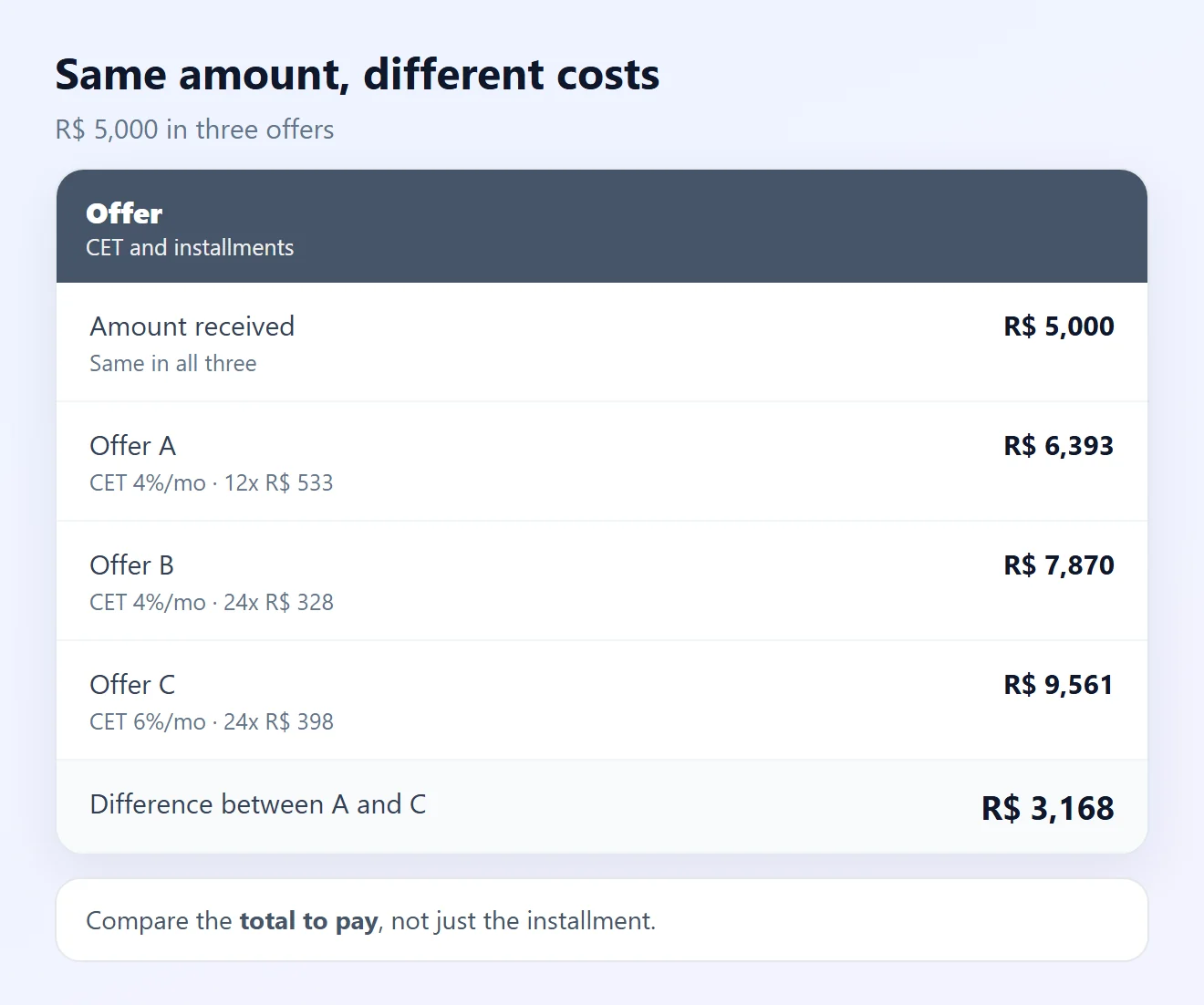
- Ask for offers from your bank, another bank and a lender or digital bank, all for the same amount.
- Compare the CET and the total to pay, not just the installment.
- The Central Bank of Brazil publishes each institution's average rates for “non-payroll personal credit”. Use them as a benchmark.
6Check that the lender is authorized
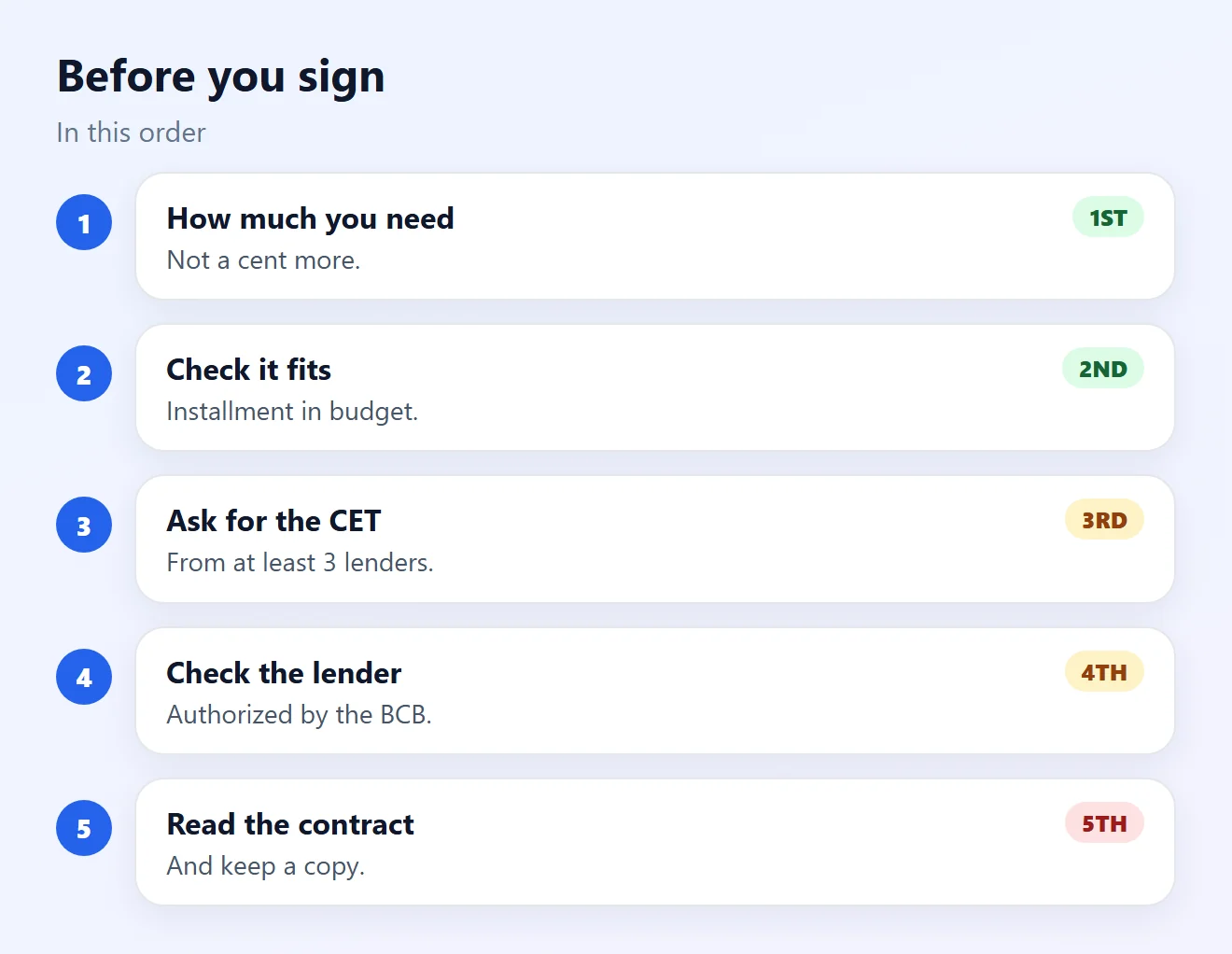
- Enter the name or CNPJ in the Central Bank's authorized institutions lookup. If it says “Nenhuma instituição encontrada” (no institution found), don't sign.
- Scammers also use well-known bank names. Use the website and phone shown in the lookup, not the ones in the message you received.
- Also check the Central Bank's complaints ranking and consumidor.gov.br.
7Spot the loan scam
- The Central Bank warns: no bank or lender can ask for an upfront payment to release credit. A “release fee”, “insurance” or “guarantee deposit” before the money arrives is a scam.
- Be wary of credit promised “with no credit bureau check”: the law forbids that kind of offer.
- The law also forbids harassment or pressure to sign, especially with older adults and vulnerable people.
8Read the contract and keep a copy
- Check that the amount released, CET, installments and total match the offer.
- Turn down insurance or add-ons you didn't ask for if they're raising the cost.
- The late fee can't exceed 2% of the installment. The lender must give you a copy of the contract.
9Pay it off early when you can
- You have the right to pay off the loan early, fully or partly, with a proportional reduction of interest and charges.
- Prepaying the last installments usually gives the biggest discount. Ask the lender for the updated amount before paying.
10Keep track and renegotiate early
- On the Central Bank's Registrato, you can see every loan in your name and find out whether someone took out credit using your data.
- If the installment starts to pinch, contact the lender before you fall behind. Late interest and negative records make the debt more expensive.
See how to negotiate bank debt and what to do about over-indebtedness.
Problem and fix
| Problem | Likely cause | Fix |
|---|---|---|
| Low installment, high total | Long term | Choose the shortest term that fits (step 3) |
| Low interest, but expensive overall | Fees, IOF tax and insurance | Compare by CET (step 4) |
| Asked for a fee to release it | Scam | Don't pay and check the lender (steps 6 and 7) |
| Insurance I didn't ask for | Product added to the offer | Ask to remove it before signing (step 8) |
| A loan I didn't take out | Misuse of your CPF | Check Registrato and contact the institution (step 10) |
| Installment became heavy | Budget changed | Renegotiate before falling behind (step 10) |
Frequently asked questions
What is the CET?
It's the Custo Efetivo Total (total effective cost): a yearly rate that adds up interest, fees, taxes and insurance. It's the right number to compare offers.
Must the lender disclose the CET?
Yes. Brazil's Consumer Protection Code requires disclosing, before you sign, the CET, the monthly interest rate, late charges, the installments and the total to pay.
How long is a loan offer valid?
By law, the offer must be valid for at least 2 days.
Is it normal to pay a fee before getting the loan?
No. The Central Bank warns that no bank or lender can ask for an upfront payment to release credit. That's a scam.
How do I know a lender is trustworthy?
Look up its name or CNPJ in the Central Bank's list of authorized institutions and check complaints in the Central Bank ranking and on consumidor.gov.br. Use only official contacts.
Do loans “with no credit check” exist?
The law forbids offers claiming credit will be granted without a credit bureau check or without assessing your finances. Be wary.
Can I pay off the loan early?
Yes, fully or partly, with a proportional reduction of interest and other charges.
What is the late fee?
The fee can't exceed 2% of the installment. On top of it there is late interest, which must be stated in the contract.
Is it worth taking a personal loan to pay my credit card?
It can be, if the CET is lower than the revolving interest and you stop using the limit. Compare the totals first.
Personal loan or payroll loan?
A payroll loan usually has lower interest but is deducted directly from your income. If you can get both, compare the CET and the total to pay.
Related content
More practical solutions in Loans.

Sources
- Consumer Protection Code (Law 8,078/1990), arts. 52, 54-B, 54-C and 54-D (in Portuguese)
- gov.br: Central Bank warns about fake loan scams (in Portuguese)
- gov.br: look up institutions authorized by the Central Bank (in Portuguese)
- Central Bank of Brazil: interest rates by institution (in Portuguese)
- Central Bank of Brazil: Citizen's Calculator, fixed-installment financing (in Portuguese)
- Central Bank of Brazil: financial citizenship glossary, CET (in Portuguese)
The images on this page are illustrations created by Fixfy. Offers A, B and C are examples with hypothetical rates.